Thursday, December 12, 2013

Peg Laterals

At times, for several reasons, the maxillary lateral incisors do not form properly. Maxillary lateral incisors are the smaller teeth on either side of the top two front teeth. This malformation of the tooth is genetically determined. The malformation can take on several different appearances, and both teeth or only one of the teeth may be affected. The teeth can be shorter in height or lesser in width or a combination of the two. This type of deviation from the normal shape of the tooth is called a peg lateral incisor


Restorative Possibilities
If the peg tooth (or teeth) is just slightly more narrow than normal and there is a space available on either side or both sides of it, the tooth can be bonded with a directly placed composite restoration. This is the most common treatment. The results are very positive and can last a long time. An excellent color match is not difficult to obtain. The procedure is similar to closing a diastema (a naturally occurring space between teeth).

If there is not enough space on either side to place the composite material, orthodontics might be required to provide room for the bonding. Diagnosed early, this is not a problem to do. If the patient waits until adulthood for the orthodontics, shifting of the teeth may have forced the peg tooth out of line, and more extensive orthodontics may be needed.

If the peg tooth is too small in both height and width and there is adequate space remaining, the tooth can still be rebuilt with a composite. However, if the patient is older and there is a significant amount of tooth to be replaced, a porcelain restoration may be more appropriate. This restoration is made in a laboratory with excellent esthetic results. It will last a very long time. It is more expensive to accomplish and will not be placed until the mouth is fully developed and the teeth and gum tissue are in their “adult” position¾sometime after age 18.

In brief, restoration of a peg lateral can be done with composite resin (in all ages) or porcelain (after age 18). Size and position of the teeth will determine what is done and when. As soon as it is noted, plans should be made for eventual restoration. It is important to make sure there is sufficient space for the proper length and width bonding. This spacing may happen naturally or need orthodontic assistance.

If you have any questions about peg laterals and their restoration, please feel free to ask us at (512)250-5012.  -Omni Dental Group

Wednesday, December 11, 2013

Topical Fluoride: In the Office and At Home

Why Topical Fluoride
Everyone is familiar with the dental advantages of fluoride supplements, systemically administered to children while their teeth are forming. Research on this type of fluoride treatment shows a 35% reduction in tooth decay. The use of fluoride to reduce and eliminate decay is one of the most highly studied and documented public health measures yet. In this office, we have recommended this 4-minute tray-type fluoride delivery at least twice a year, usually after your periodic dental hygiene recare appointment. We have found that this type of preventive aid does four things: 
· Reduces the solubility of enamel to acid attack, making the teeth more resistant to decay
· Aids in remineralizing the tooth enamel where decay has just begun
· Longer-term, daily use reduces tooth sensitivity to temperature changes
· Reduces the surface tension of the enamel so that plaque does not easily adhere to the tooth
Research has also shown that you can benefit from a nonprescription topical fluoride rinse, especially if you use it faithfully every day. There is, in addition, a reduction in decay seen if you have the stronger concentration topical fluoride that we use in this office. It is applied four times each year. Decay reduction can be as high as 30%! If you have had recent active decay, no matter what your age, we will recommend this routine for you.

Special Fluoride Applications
Another option for topical fluoride is available to patients with tooth or root sensitivity, higher and chronic decay levels, root decay, or dry mouth syndrome (xerostomia). If you have been diagnosed with any of these dental problems, we will make custom fluoride trays for you. We will then either prescribe or dispense a high-concentration fluoride gel product for you to use nightly in the tray.

The number of weeks that you will need to apply tray fluoride in this manner depends on your oral condition. If diminished salivary flow has caused an increase in your decay rate, you will need to follow this procedure until saliva flow returns to normal. In the case of sensitive teeth, you will need to follow this procedure until the sensitivity is reduced. However, please note: sensitivity reduction is usually a gradual process; do not expect overnight improvement. Root desensitization may also require that additional materials be placed over the area as an adjunct procedure.


If you have any questions about the use of topical fluorides in the home or dental office, please feel free to ask us at (512)250-5012. –Omni Dental Group  

Tuesday, December 10, 2013

Microdentistry: Preventive Resin Restoration

With the advent of adhesive dentistry (bonding), the concept of how a tooth should be prepared for a filling has changed. In the old days, if you were to have a silver filling (silver amalgam filling material was invented in the early 1800s), the tooth would have to be drilled beyond what was necessary to remove the decay. The extra drilling is needed for undercuts to be placed to mechanically retain the silver material. The extra tooth that was removed would make the tooth weaker. With adhesive dentistry, the ability of the dentist to bond (attach) composite resin materials to the tooth has changed this concept. Now, all the dentist needs to do is remove decay and then bond the resin into position. This means less drilling, and the tooth remains stronger. The reduced need for drilling of a tooth allows the dentist to perform microdentistry procedures. The technical expertise needed on the part of the dentist increases while removal of the tooth structure decreases. Innovative ways of removing decay are constantly being developed. With use of magnifying loupes, dyes that can selectively stain decay, and the new bonding materials, more of the tooth is preserved.


A preventive resin restoration is a combination of a microdentistry procedure and a conventional tooth sealant. In the old days, when a back tooth became decayed, the nondecayed grooves near the decayed portion were removed routinely to prevent further decay from starting. With a preventive resin, only the decay is removed. Bonding is placed to restore the area and a resin sealant is then bonded over the remainder of the tooth to prevent further decay. In this way, less drilling is needed and the tooth remains strong.

In preparing a tooth for a preventive resin, a traditional dental handpiece drill can be used to remove the decay, or the recently re-introduced air abrasion unit may be used. An air abrasion unit emits a stream of aluminum oxide or other smaller-particle sand-like material under high pressure. This is equivalent to sandblasting¾but on a very small scale. The particles under high pressure quickly abrade away the decay, quietly and often with no need for a local anesthetic injection to numb the tooth. Another major advantage of abrasion dentistry is that the “sandblasting” does not cause cracks to form in the brittle tooth enamel. The traditional dental drill does cause cracks to radiate out from the preparation. These cracks have been implicated in an accelerated deterioration of the tooth and need for filling replacement. With abrasion dentistry this problem can be eliminated. Air abrasion cannot yet be used to prepare crowns and bridges or any type of cast and laboratory-fabricated restoration.


If you have any questions about microdentistry and preventive resin restoration, please feel free to ask us at (512)250-5012. –Omni Dental Group

Monday, December 9, 2013

Enamel Recontouring

Most people want straight, beautifully aligned, white teeth. Unfortunately, most people are not naturally born that way. When teeth are in poor alignment, rotated, tilted, and/or crowded, one obvious way to correct the problem is by orthodontics (braces). However, there are situations where it may not be possible or desirable to use braces to straighten teeth. You might feel that you are too old (although this is rarely the case), the cost of the orthodontics may preclude their use, you may not want to wear braces, or perhaps there are only a few areas that need attention and full orthodontics are not indicated.


In certain select cases, the appearance of your top and bottom teeth can be slightly or dramatically improved by recontouring the enamel. The upper and lower incisors and canines can be routinely altered. Sometimes teeth further back in your mouth can also be cosmetically improved. Recontouring is useful when there is slight to moderate overlapping of the front teeth, uneven wear, or teeth that do not have their biting and incising edges in harmony, in effect, an uneven “picket fence” look. Enamel recontouring is a painless procedure and no local anesthetic is needed. The enamel that is overlapping or poorly shaped is removed, recontoured, and polished. Different amounts of enamel may be removed from different teeth. The teeth do not become prone to decay, are not made more sensitive to temperature changes, and are not made significantly weaker or damaged by the procedure.

Many times, recontouring is all that is necessary to significantly improve your appearance. Other times, when the poor alignment is more pronounced, it may be done in conjunction with a bonding procedure.

The procedure is not difficult for the patient and can often be done in only one appointment. The resulting change is immediate and permanent. It does take an artistic approach on the part of the dentist to determine what possibilities for change exist. We need to determine what enamel needs to be removed, where we must add material, and where orthodontics is the treatment of choice. The fees are reasonable and depend on the extent of the treatment.


If you have any questions about enamel recontouring, please feel free to ask us at (512)250-5012.

-Omni Dental Group

Thursday, December 5, 2013

Infection Control Procedures

All instruments that are to be reused are properly cleaned according to the most current infection control protocol appropriate to dentistry. Instruments are then placed in pouches and sterilized. The pouches are opened in the presence of a patient only as they are needed for a dental procedure. We have been sterilizing instruments this way for years, long before any governmental regulations.

When possible, we purchase single-use only, disposable items, which are properly discarded after one use. The cost of disposable items is greater than the cost of reusable dental products and instruments.

The dental handpieces have always been disinfected and sterilized according to the manufacturers’ directions. All handpieces are sterilized after each use. Each year, we spend thousands of dollars on new handpieces and on repairing handpieces damaged by the sterilization process.

We have always been concerned with proper sterilization: this is not new for this office. What is new is the cost. With the greater demand for sterilization and disinfection products universally, the cost to us has risen dramatically. Calculations show that sterilization procedures add considerable cost to a patient visit-between 8 and 15 dollars per patient visit. This cost estimate covers sterilization and disinfection supplies, increased cost of more frequent purchases and repairs of dental handpieces, and the cost in time (approximately 12 to 15 minutes) to properly clean the treatment room after each use. There is also the cost of the salary paid to the dental team members who spend more time with mandated infection control procedures and, therefore, less time with the actual dental treatment of the patient. These added costs are considerable. Dental insurance carriers have not yet increased payments to reflect the increased costs.

We are unwilling to compromise your health and our health by not following proper infection control guidelines. We follow Occupational Safety and Health Administration (OHSA) guidelines (for the employee and workplace) and Centers for Disease Control (CDC) guidelines (for the patient). Other than the newly required mountain of paperwork, our office did not have to make any changes to meet the CDC guidelines; we were already following all the proper infection control guidelines and procedures.

If you have any questions about infection control procedures, please feel free to ask us at (512)250-5012.

-Omni Dental Group.

Wednesday, December 4, 2013

Dental and Oral Anatomy

Dental and Oral Anatomy
                                                                             
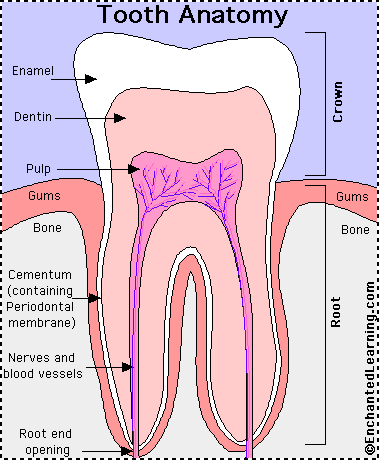
The Anatomy of Teeth

Crown: the portion of the tooth that is visible above the gumline

Root: the portion of the tooth that is not normally visible and is below the gumline

Enamel: the outer covering of the tooth crown
Teeth are one of the body’s hardest naturally occurring substances. They are strong enough to adequately resist normal wearing that occurs over a lifetime of chewing food. Teeth are composed of several different parts¾enamel, dentin, cementum, and pulp (nerve) tissue. The enamel is the outside covering of the tooth. It is the part of the tooth that you normally see when a person smiles. Yet, while enamel is very hard, it is also very brittle. It is mostly inorganic in nature. When fluoride is incorporated into the enamel (systemically when the enamel is forming, topically when the tooth is in the mouth), it becomes more resistant to acid attack and decay. The enamel of the tooth covers the inner layers of the crown portion of the tooth.

Dentin: the layer beneath the enamel
Dentin is not normally visible. Only when a tooth breaks or is worn can it be noticed. Dentin is darker in color, softer, and more resilient than enamel. Small nerve fibers running from the dentin to the pulp can make the tooth sensitive to temperature changes or other stimuli when dentin is exposed to the oral cavity. If a tooth is sensitive, many times, exposed dentin is the reason. Dentin, when exposed to the oral cavity, will wear away faster than enamel, and this can lead to other dental problems.

Pulp: the innermost tooth layer
The pulp of the tooth is composed of soft, highly organic material¾mostly nerve fibers and blood vessels. When the pulp becomes damaged from deep decay or other dental problems, it can become abscessed and must then be treated with endodontic therapy (root canal) or be extracted.

Cementum: the outer covering of the root of the tooth
The root of a tooth is normally not seen. It is surrounded and covered by bone and gum tissue. The root is covered by a thin layer of cementum. Cementum is similar to dentin in composition and can decay or wear away if exposed in the mouth. Fibers that attach the tooth to the bone are embedded in the root cementum and serve as shock absorbers during normal functioning, such as chewing.

Bone: the structure that makes up the jaws
The bone that surrounds each tooth is less dense in the upper jaw and more dense in the lower jaw. As with bone elsewhere in the body, it can undergo resorption and repair. The spaces in which the teeth rest, called sockets, provide the pathways for a rich supply of blood and nutrients and other vital fluids to reach the teeth.

If you have any questions about dental and oral anatomy, please feel free to ask us at (512)250-5012.

-Omni Dental Group

Tuesday, December 3, 2013

Cast Gold Restorations


A cast gold restoration will give you the longest and most trouble-free service of any type of dental material available today. A full gold crown can be used when a tooth has undergone significant destruction. A much smaller and conservative type of restoration, called an inlay, is used when more enamel and original tooth structure exists. Cast gold restorations have been known to last for 25 to 40 years. These restorations are not likely to break. The gold casting is held in place by a dental cement (glue). It can even be bonded.


These gold restorations are especially recommended for patients who brux (grind) or clench their teeth. They are indicated for patients who want the most trouble-free, longest-lasting type of dental restoration. They are recommended when there is moderate to extensive tooth destruction. The gold castings are then used to cover the biting surfaces and weakened areas and to prevent fracture during normal chewing. Only cast restorations can do this. A laboratory is involved in the fabrication of the gold crown or inlay. Therefore there will be two visits needed for the restoration to be completed. A temporary plastic crown or inlay will remain in place on the tooth while the final restoration is being made. The appointments will be about 2 weeks apart.

Initially, the cast gold restorations are more expensive than silver fillings. Because cast restorations do not have to be redone as frequently as silver (if at all), you end up saving time and money in the long run. The longer the gold restorations are in place, the less you eventually spend getting the same tooth restored over and over. Another potential disadvantage of cast gold is the color. They are an obvious “wedding band” yellow. If you want restorations to be the same color as your teeth, cast gold is not for you. Depending on the type of restoration you require, the gold color may be able to be disguised or hidden when you smile, but when you open your mouth, the color may be visible. If this is objectionable to you, you should consider a tooth-colored inlay, onlay, or porcelain fused to metal crown. You may be able to have the esthetics you want: gold castings for back teeth that are not easily seen and tooth-colored restorations where they might be seen.

For patients who desire the longest-lasting, most trouble-free restoration and who understand the initial investment in time and money and don’t find the display of yellow gold objectionable, this is the restoration of choice. We highly recommend this type of restoration.

If you have any questions about cast gold restorations, please feel free to ask us at
(512)250-5012.
-Omni Dental Group