Showing posts with label implants. Show all posts

Monday, January 30, 2017

Congenitally Missing Teeth

Some of us will have 32 teeth develop during our lifetime. This has been considered a normal complement of teeth. More often than not, however, we do not develop a full set of 32 teeth. It is quite common for people to be missing one or more of the third molars (wisdom teeth). And as the jaw sizes of modern human beings have decreased in size, it is not unusual that there is no room for the proper placement of the third molars in a mouth, and they must be extracted.

Not as common, but not at all unusual, is a condition in which certain permanent front teeth never develop. When permanent teeth don’t develop, they are considered to be congenitally missing. The term for this condition is congenitally missing teeth. When this happens, it is frequently one or both of the upper lateral incisors, which are smaller teeth on either side of the two top front teeth. Less often, the permanent eyeteeth (canines) or premolars don’t develop.

The problem that results from congenitally missing teeth involves the space where the tooth (teeth) should have been. The teeth nearest the space shift into different positions to fill the gap, often resulting in a crowded smile—when in fact, some teeth are missing!

The problems resulting from missing permanent teeth can be reduced or eliminated with early detection and a plan for future treatment. The usual treatment involves orthodontics to move the permanent teeth into better position or keep the permanent teeth in the correct location. Because we treat missing lateral incisors so often, the treatment routine is well established. The best aesthetics, the most natural look, will be achieved by leaving the adjacent permanent central incisors and canine teeth in their customary places.

When there are missing lateral incisors, it is likely that we will recommend moving the eyeteeth (canines) into their positions. This will keep the bone in the missing tooth space at the proper level. We will then recommend moving the eyeteeth back into their proper positions. This may sound like extra treatment, but it is needed to keep the bone at the proper height for future tooth replacement treatment.
The sequence of treatment is orthodontics as early as necessary to maintain the space. The further the teeth have shifted from this original position, the more orthodontic treatment will be necessary. Then, while the child and mouth are growing, a removable replacement tooth is made. This appliance is worn until the teeth are ready to receive the implant or bridge, after age 18 or so when the mouth and dental structures are more mature.


When the permanent teeth further back in the mouth are missing, it is common for baby teeth to be retained in these spaces. Sometimes the baby teeth can last for years, but they do not have the root structure to remain stable over a lifetime. Because the retained baby teeth are meant for a small mouth, they do not have the right size, shape, or function as the permanent teeth. When lost, they can be replaced with implants or a bridge. Your own particular situation will determine the best course of treatment. 

Monday, November 14, 2016

Dental Detectives: What Fossil Teeth Reveal About Ancestral Human Diets


When scientists want to know what our ancient ancestors ate, they can look at a few things: fossilized animal bones with marks from tools used to butcher and cut them; fossilized poop; and teeth. The first two can tell us a lot, but they're hard to come by in the fossil record. Thankfully, there are a lot of teeth to fill in the gaps.
"They preserve really well," explains Debbie Guatelli-Steinberg, a dental anthropologist at Ohio State University. "It's kind of convenient because teeth hold so much information."
The structure of a tooth and even the amount of enamel, for example, hint at what the teeth are adapted to eat.
Look at molars: Thick enamel on a molar is good for crushing foods. It suggests an animal used its teeth to grind seeds or crush the marrow out of bones. Thin enamel on a molar, while delicate, causes sharp edges — perfect for slicing and tearing foods like leaves and fruits.
However, these are just clues to some of the things the animal could have been eating, not what it ate every day, says Peter Ungar, an anthropologist at the University of Arkansas.
Article continues after sponsorship
"If you eat Jell-O almost every day of the year, but sometimes you need to eat rocks ... you want teeth that can eat rocks," he explains. So, teeth are usually adapted for the toughest component of an animal's diet, not what it eats on a daily basis.
To see what an animal was actually eating, Ungar studies something called dental microwear, the marks left behind by food on teeth. As we chew on say, a celery stick, hard particles — either bits of silica from the plants' cells or sand and grit from the surrounding environment — are dragged across and pressed into our teeth. When we chomp down on something hard, like a nut, the crushing force leaves microscopic pits behind. When we tear through tough grasses — which may not sound appetizing now, but it's likely some of our ancestors did eat them — by moving our teeth side-to-side, the teeth get tiny, microscopic scratches.
"I call it a foodprint," Ungar says.
These foodprints can paint a pretty good picture of what an animal ate in the weeks leading up to its death — a sort of last meal. A study of such microwear revealed that Australopithecus afarensis, our 4 million-year-old ancestor best known by the famous fossil of Lucy, probably ate tough grasses and leaves. And it looks like early members of our genus, Homo — like Homo habilis, which lived 2.4 million years ago or Homo erectus, which even overlapped with humans about 100,000 years ago — were omnivores like us. They ate a variety of foods like meat, plants, fruits, "Anything they wanted!" says Ungar.
So we can tell what an animal was adapted to eat and what it ate shortly before it died. But to know what it ate for longer periods, scientists have to look deeper — to just below the surface of a tooth — for certain molecular signatures left behind from daily meals.
As our teeth grow in early childhood and adolescence, they incorporate certain molecules from the food we eat. The same was true for our ancestors. Paleoanthropologists studying ancient diets are especially interested in carbon molecules in our ancestors' teeth, because they come from plants and stick around for a long time.
Some groups of plants use mostly one form, or isotope, of carbon. Plants with C3 isotopes are usually found in fruits and leaves — things that grow in forests. Plants with C4 isotopes, like grasses and sedges, grow in savannas.
Data from isotopes confirmed that Lucy's species switched from forest foods to savanna foods about 3.5 million years ago. That transition from forests to grasslands may have played a key role in human evolution, explains Matt Sponheimer, a paleoanthropologist at the University of Colorado, Boulder. Some researchers even think that adding more grass to our diets gave our ancestors more foods to eat and places to live as the early climate changed causing Africa's forests to shrink.
Our understanding of what our ancestors ate has become more complex and richer with time, as scientists have applied newer, more advanced techniques to study teeth. When Mary Leakey dug the 2 million-year-old human ancestor Paranthropus boisei out of Olduvai Gorge in Tanzania in 1959 year, she noticed the fossil's wide, thick molars. The skull had huge cheekbones to accommodate strong chewing muscles and powerful jaws, suggesting the species was well-suited for crushing nuts. So, Paranthropus boisei was nicknamed Nutcracker Man.
But when Peter Ungar and others examined Nutcracker Man's teeth, they barely found any foodprints, so they decided he likely ate soft foods like fruits.

An analysis of Nutcracker Man's tooth isotopes revealed C4 carbon, which comes from savannas, not fruit-filled forests.
Today, researchers think that Paranthropus boisei ate a varied diet with lots of different foods, but he mostly ate tough grasses and sedges.

Teeth from more recent fossils reveal more because they have more isotopes preserved in them. For example, the nitrogen in the teeth of Neanderthals can reveal whether the protein they ate came from plants or animals. It's one of many reasons researchers think Neanderthals hunted large mammals, though scientists have also found fossilized plants stuck in Neanderthal teeth.
Researchers were even able to use isotopes to find out when one Neanderthal started weaning her baby. As teeth grow, they lay down layers of enamel. And barium, a molecule children get from breast feeding mothers, builds up in baby teeth until the mother stops nursing. By comparing barium in a Neanderthal tooth with levels in donated present day baby teeth, the scientists were able to find out that the Neanderthal baby had been weaned at about seven months.
We can even use teeth to tell if someone moved between places with dramatically different foods or soils. Since wisdom teeth are the last adult teeth to come in, comparing them to an early emerging canine tooth can give scientists a dietary snapshot across time. Say someone was born in Africa and moved to a new continent as a preteen, while wisdom teeth were still growing. A comparison of the isotopes in the teeth would reveal the story of that migration.
There's still a lot to learn from teeth, and a lot of fossil teeth still being discovered, says Sponheimer. And as the tools to study them get more sophisticated, teeth are providing a richer picture of "who we are and how we came to be," he says.

By: Erin Ross, NPR
http://www.npr.org/sections/thesalt/2016/10/25/497094756/dental-detectives-what-fossil-teeth-reveal-about-ancestral-human-diets

If you have questions or would like to schedule an appointment, please contact Omni Dental Group at one of our three office locations listed below:

North Austin on Hymeadow Drive: (512) 250-5012
Central Austin on Jollyville Road: (512) 346-8424
South Austin on William Cannon: (512) 445-5811

Friday, July 18, 2014

Implants: Procedural Overview

Compared to a routine dental filling or crown (cap), replacement of a missing tooth or teeth with implants is a more complicated and lengthy process. It will take several phases. A periodontist or an oral surgeon will place the implant surgically. Then we will place the tooth or visible portion.

Phase One
The specialist evaluates the position, suitability, and strength of the bone that will surround the implant. This information determines the length and width of the implants and how many implants will be necessary to replace the missing teeth. Impressions of all your teeth will be taken for study models in order to design the shape of the tooth or teeth to be implanted. A surgical guide will be made to indicate to the surgeon where the implants should be placed.  

Phase Two
Surgical procedure is done to place the implant in the bone. A local anesthetic is given, and the gum tissue is lifted to expose the implant site. The implant is placed into the bone and the gum is closed over it. You will not see the implant while integration with the bone takes place. The integration takes 4 to 6 months. After this time, the site is opened again and a healing collar will be threaded into the implant. This will guide the tissue into a shape that is needed for the future crown(s). The time that the healing collar needs to be in place will vary from person to person, but will be at least several weeks.

Phase Three
Once the tissue shape is sufficient, specific attachments and components will be fitted to the implant. The implant components are similar in function to the wall or plaster anchors used to hang pictures on drywall. The healing collar is removed. Implants transfer copings, analogs, and other items are used to take an impression of the site. The healing collar is then put back on. The impressions and implant components are sent to the laboratory for fabrication of implant posts and temporary acrylic crowns.

When the temporary crown or bridge is returned from the laboratory, the healing collar is removed and the implant attachments are fasted to the implant. The temporary crowns are then seated and adjusted. They will be held in place by temporary cement or with screws, depending on your certain situation. We will explain the advantages and disadvantages of each in your particular case at the time you decide to have the implant

Temporary crowns are placed because the bone that supports and surrounds the implant must be given the opportunity to be put into function gradually. Implant techniques dictate that the implants be slowly brought into biting function. This means you will be returning several times to have more acrylic added to the temporary crown. After the implant and temporary crown have been in biting function for a few months, the final crown(s) will be fabricated and cemented or screwed into place.

Maintaining All Your Teeth
To keep your implants and your natural teeth healthy and functional for the longest time possible, clean the implant and your other teeth daily, as instructed. You will also need to come in for dental hygiene recare appointments at a 3- to 4-month interval. You have invested time and money in these state-of-the-art tooth replacements. Maintaining them as instructed will give you the best chance of success.

We feel that the benefits of replacing teeth with implant-supported crowns and bridges far outweigh the inconvenience of the long start to finish time. This is especially true when the teeth on either side of the implant are sound, unfilled teeth that would not otherwise require dental treatment. Implants help you preserve your nature tooth structure.

If you have any questions about dental implants, please feel free to ask us.

Monday, June 30, 2014

What Are Implants?

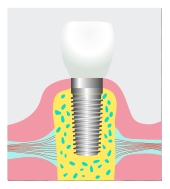
Have you lost your teeth due to: severe tooth decay, gum disease, trauma, or even a failed root canal? You may qualify for implant treatment. Dental implants are used to replace one or more missing teeth in your mouth. Implants are made of titanium or similar materials that are well suited to the human body. Implants are artificial replacements for teeth roots that support a restoration or a dental appliance. 


Twenty-five years ago, if someone described how missing teeth could be replaced with implants, it might have been called a miracle. Ten years ago, the use of dental implants to replace missing teeth might have been called astounding. Today, implant procedures are called routine. We would like you to have a basic understanding of what implants are, what can be expected from them, and what limitations they might have in your specific area of need.

dental implant Austin
A dental implant is a synthetic metallic root substitute that is placed or implanted in the jaw bone. It can be used to replace a single missing tooth, provide an abutment (anchor or retainer), replace several missing teeth, or provide added retention to a removable dental appliance such as a full denture. In fact, if you are missing all of your natural teeth, it is possible to have maxillary (upper) and mandibular (lower) fixed replacements. The replacements do not come out and you cannot remove them yourself.

Two separate events are needed when replacing a missing tooth with an implant. First is the surgical phase in which the implant is placed. In the second phase, the replacement teeth are constructed and fixed into proper position.

The implant placement procedure involves making a small incision in the gum area where the implant is to be placed, preparing a site in the underlying bone, inserting the implant into the prepared site, and closing the tissue over the implant with several sutures. This area is left undisturbed, usually for 4 to 6 months. More healing time may vary due to the density of your bone. The lower jaw is composed of bone that is more dense than that of the upper jaw. This healing time allows for the slow integration of the implant within your jaw. The implant is held in place by the bone.
http://paulkorb.com/wp-content/uploads/dental_implant_01.jpg 
After the healing and integration of the implant, the placement site is exposed by reopening the gum. A post will then be fastened to the implant by cement or with internal threads. The crown, bridge, or other type of replacement will be attached to this post. Some dentists prefer to do all phases of the implant procedure themselves, but many choose to perform either the surgical or prosthetic (the actual construction of the replacement device) only. If this is the case, a periodontist or oral surgeon will perform the surgical portion of the implant placement.

Implants are very successful. Maxillary and mandibular implants are more than 90% successful. Lower implants have a somewhat higher success rate than upper implants. Occasionally, implants fail, but it is not common. Chances of an implant failure, many times, can be determined during or after the surgical phase before the replacement tooth or teeth are constructed.

Smokers take note: There is a heightened risk of dental implant failure among smokers - as much as a 20% greater failure rate!

We will discuss with you the requirements and options for your particular situation. There are usually several possibilities for effectively replacing missing teeth. It is important to decide on the design of the implant-retained replacement prior to the actual implant surgical procedure. Position and alignment of the replacement teeth need to be carefully considered before determining the location of the implant.

If you have any questions about implants, please feel free to ask us.