Showing posts with label enamel. Show all posts

Friday, February 17, 2017

Enamel Recontouring


Most people want straight, beautifully aligned, white teeth. Unfortunately, most people are not that lucky. When teeth are in poor alignment, rotated, tilted, and/or crowded, the obvious way to correct the problem is by orthodontics (braces or Invisalign aligners). However, there are situations in which it may not be possible or desirable to use braces to straighten teeth. You might feel that you are too old (although this is rarely the case), the cost of the orthodontics may be beyond your current means, you may not want to wear braces, or perhaps there are only a few areas that need attention and full orthodontics are simply not indicated.

In certain select cases, the appearance of your top and bottom teeth can be slightly or dramatically improved by recontouring the enamel. The four top and four bottom incisors and canines can be routinely altered. Sometimes teeth further back in your mouth can also be cosmetically improved. Recontouring is useful when there is slight to moderate overlapping of the front teeth, uneven wear, or teeth that do not have their biting and incising edges in harmony, creating an uneven “picket fence” look.
Enamel recontouring is usually a painless procedure and no local anesthetic is needed. The enamel that is overlapping or poorly shaped is removed, recontoured, and polished. Depending on your individual needs, one or several teeth may require some reshaping. Different amounts of enamel may be removed from different teeth. The recontoured teeth do not become more prone to decay, are not made more sensitive to temperature changes, and they are not made significantly weaker or damaged by the procedure.
Many times, the recontouring is all that is necessary to significantly improve your appearance. Other times, when the poor alignment is more pronounced, it may be done in conjunction with bonding of resin or porcelain to teeth. Your treatment will depend on your present conditions and on what you would like to see changed.


The procedure is not difficult for the patient and can often be done in only one appointment. The change is immediate and permanent. It does take an artistic flair on the part of the dentist to see what possibilities for change exist. We need to determine what enamel needs to be removed, where we must add, and where orthodontics is the treatment of choice. The fees are reasonable and depend on the extent of the treatment.

If you have any questions about enamel recontouring, please feel free to ask us!  
Hymeadow: (512) 250-5012
Jollyville: (512) 346-8424
West William Cannon: (512) 445-5721

Wednesday, February 15, 2017

Acid Reflux (Gastroesophageal Reflux Disease)


Teeth are so hard you would think they would be indestructible and that they would not be adversely affected by anything. Due to the strength of enamel and bone, they should remain the same from the day the teeth come into the mouth to the day they are no longer needed. Unfortunately, this is far from true. While we would like the think of teeth as being strong and unchanging, most people know that teeth can be damaged by tooth decay-causing bacteria. We know, too, that teeth can be damaged by mechanical means—attrition caused by tooth grinding and clenching and abrasion caused by improper toothbrushing. However, few people know that there is a third factor that can destroy teeth—chemical erosion.

Chemical erosion is caused by excess acid coming in contact with a tooth for extended periods of time. The acid attack can be self-inflicted (bulimia) or more commonly from a problem with acid reflux. In acid (gastric) reflux, the acidic and partly digested contents of the stomach are returned back into the throat and oral cavity. Normally, the lower esophageal sphincter muscles (LES), connecting the esophagus with the stomach, closes once food passes into the stomach. This closure prevents the stomach contents from flowing back up into the esophagus. Acid reflux occurs when this sphincter does not work properly and allows acidic fluid to return to the esophagus and higher—the mouth.

This condition can actually be noted by a dentist long before it is acknowledged by a patient or physician. The dentist will see a characteristic smooth and circular erosion of the cusp tips of the lower first molars. The cusp tips (bumps on a tooth) lose their peak, flatten, and become concave. Soon the enamel cover is broached and the underlying dentin is exposed. Because dentin is “softer” than enamel, the erosion can progress more quickly. This acid erosion has a very different appearance from tooth loss due to a mechanical etiology. Attrition and abrasion have a very sharp, edged, and well-delineated look. Chemical erosion has a softer and more rounded presentation and is localized first to lower first molars (lower first molars are the first permanent molars to erupt into the mouth) so that the permanent teeth have the longest potential exposure. When the acid refluxes (returns) to the mouth, it pools mostly around the first lower molars. This is the site of the most erosive features.

A significant portion of the population experiences acid reflux at least once a month. About 25% of those who are affected are aware of their problem. Infants and young children can be affected, and there may be a genetic component to the disease. Early diagnosis from erosion of the permanent lower first molars can be made as early as 7 or 8 years of age. A hiatal hernia may weaken the LES and cause reflux. Diet and lifestyle contribute to acid reflux. Chocolate, peppermint, citrus, tomatoes, fried or fatty foods, coffee (especially acidic coffee), alcoholic beverages, garlic, and onions are foods to avoid. Weight gain (also weight gain associated with pregnancy) and smoking (by relaxing the LES) may be contributing factors. Further information may be obtained from the Internet by going to a search engine and typing in “acid reflux”, “gastric reflux”, or “gastroesophageal reflux disease (GERD)”.

As is true with most medical and dental problems, the earlier the diagnosis is made, the easier it is to treat. If we have brought this condition to your attention, we ask that you speak to your physician. Variable factors include the nature and severity of the problem, as well as frequency and type of fluid that refluxes from the stomach. Change in diet, eating habits, and/or medication (over-the-counter or prescription) can be effective. Dentally, once the enamel is broached and the dentin becomes visible, it is recommended that the affected areas be protected by covering them with an enamel replacement—a tooth-colored bonding material. This material not only protects the dentin and enamel but it also may be more resistant to the acid than is naturally occurring dentin. Many times, drilling preparation is not needed.

If you have any questions about acid reflux, please feel free to ask us!  
Hymeadow: (512) 250-5012
Jollyville: (512) 346-8424

West William Cannon: (512) 445-5721

Xerostomia: Dry Mouth Syndrome


Xerostomia (dry mouth) is not a condition everyone should expect. You may notice it as you age due to a change in hormones, medication, and/or radiation therapy in the head and neck region.

Why Xerostomia Is a Problem
Saliva is important to oral health for several reasons. The flow of saliva helps clear debris from the oral cavity. It provides minerals necessary to support the process of remineralization. Tooth enamel daily undergoes acid attack that removes inorganic minerals from teeth. This is called demineralization. Remineralization is the opposite of demineralization. It occurs when inorganic molecules flow into a region of weakened enamel and make it stronger.

When the salivary flow is reduced, a chain of events occurs. The natural cleansing action is diminished, as are the buffering action and remineralization properties of saliva. People with diminished salivary flow experience a very fast rate of decay, many times faster and over several teeth. This type of dental decay is typically noted along the gumline, around existing dental work, and on exposed root surfaces.

Prevention
You can help prevent dental decay that can result from xerostomia:
  • Brushing and flossing correctly twice a day becomes very important.
  • Frequent sips of water during the day can help moisten the mouth and can help clear debris.
  • Daily use of a mouthrinse containing fluoride can help remineralize teeth.
  • Use a toothpaste containing sodium fluoride.
  • We recommend a daily brushing with a prescription, high-concentration sodium fluoride gel or paste. We will either dispense this or give you a prescription for it.
  • Chew sugarless gum or a rubber band to stimulate salivary flow.
  •  In moderate to severe cases, special fluoride delivery trays can be made for you to use at home. These will keep the high-concentration fluoride in a position to “soak” your teeth with fluoride for several minutes at a time.
  • We recommend that you have your teeth cleaned, polished, and an office-applied topical fluoride treatment every 3 months while the condition persists.

Dry mouth can have serious dental consequences and must be treated accordingly.
If you have any questions about xerostomia, please feel free to contact us at any of our three office locations:
Hymeadow: (512) 250-5012
Jollyville: (512) 346-8424
West William Cannon: (512) 445-5721

Monday, October 10, 2016

12 Things Your Dentist Knows About You Just By Looking In Your Mouth


While cavities and plaque build-up may be what's on your mind before a teeth cleaning, your dentist is looking for a whole lot more. "The mouth is the window to the body," says David Silverstrom, DDS, of The Silverstone Group in Livingston, NJ. "Often, diseases like cancer, anemia and diabetes will first be identified by the dentist in a regular examination, and this saves lives." And it's not just diseases- dentist can discover everything from your bad habits to your favorite beverages simply by asking you to say, "Ahh!"


1. You flossed right before your appointment—and that's the only time.
Sorry, but you can't fool your dentist into thinking you floss daily by doing so the night before or morning of your visit. "The gums of people who only floss right before a visit are bleeding or look damaged," says Timothy Stirneman, DDS, of All Smiles Dental in Algonquin, IL, "whereas, healthy gums are nice and tight and pink," he says. Kenneth Wong, DDS, of Santa Monica adds, "When patients floss right before coming for a cleaning, I can see the slices where the floss cut at the gum because they were overzealous."
2. You're pregnant.
"Nearly 40% of women will develop gingivitis during their pregnancy," says Glen Stephenson, DMD, of Prevention Dental in Boise, ID. "This is caused by increased progesterone, which facilitates the growth of bacteria, causing gingivitis. Some women will develop a deep red lump on their gums called a pregnancy tumor or pyogenic granuloma." (This type of tumor is completely benign and will go away after the pregnancy is over.) Stirneman adds that most women are typically pretty far along before their gums start bleeding, so it's not as though a dentist will magically "discover" that a patient is pregnant.


3. You bite your nails.
Without looking at your hands, a dentist may be able to detect this habit. "Signs include chips and cracking of the teeth, plus wear and tear on the teeth from the constant stress on them," says Keith Arbeitman, DDS, of Arbeitman & Shein in New York City. "This can cause your teeth to become uneven and lead to jaw pain and discomfort." Kyle Stanley, DDS, of Helm, Nejad, Stanley in Beverly Hills adds, "Patients that bite their nails using their front teeth usually have leveled off, flat front teeth. The nails themselves are not what cause the damage, but rather the contact that occurs between the top and bottom teeth," he says.
4. You used to suck your thumb.
"Most children that suck their thumbs or a finger have no long-term effects from the habit," says Stephenson. "However, those who did so past the age of seven or eight may show significant changes to their bite or the position of their teeth. Much of that can be corrected through orthodontic treatment, but some telltale signs can remain." Alice Lee, DDS, of Montefiore Medical Center in Bronx, NY, adds, "We can sometimes see protruding front teeth, and this can impact how kids' jaws are coming together and growing and can also impact their speech."
5. Your bad breath may mean something.
"General bad breath can be categorized as halitosis," says Arbeitman. But dentists are also trained to identify "fruity" smells and "fishy" smells, which can mean numerous things. " 'Fruity' breath could indicate uncontrolled diabetes or a dietary fast that has gone too far, while 'fishy' breath could be a sign of kidney or liver failure," he explains. If the smell is "very foul," says Arbeitman, it could be anything from gastroesophageal reflux (GERD) to an underlying lung abscess and bronchitis to a tonsil stone. Timothy Chase, DMD, of SmilesNY in New York City, adds, "The first thing the dentist should do is rule out the odor coming from the teeth and gums. After that, he should recommend that the patient see an ENT to rule out sinus issues, and a GI doc to rule out reflux issues."
6. You may have an eating disorder.
"Many patients are surprised that their dentist is the first one to ask about eating disorders," says Chase, "but bulimia exhibits a very distinct pattern of tooth wear that your dentist can easily identify." Stephenson notes that, "This erosion happens almost exclusively on the tongue-side of the front teeth and can contribute to increased cavities." But Silverstrom is quick to point out that acid erosion on the back of a patient's teeth does not always indicate an eating disorder. He says other possibilities include acid reflux and the use of antidepressants or mood-elevating drugs, both of which reduce the amount of saliva in the mouth, thereby upping the odds of acid damage.
7. You have a sinus infection.
"Often patients will call saying that they need a root canal," explains Ira Handschuh, DDS, of The Dental Design Center in NY, "when in fact it's actually a sinus infection and not a tooth problem at all." The reason, he explains, is because the roots of the top teeth are positioned in the same area as the floor of the sinuses. And both sinus infections and toothaches can show symptoms of pressure. "A simple home test is to have a patient bend over to touch their toes. If the pressure or pain increases just by doing this, the pain is most likely not tooth-related and he should see his ENT or primary care physician before coming to the dentist," he advises.

8. You have a vitamin deficiency. "A deficiency of vitamins and minerals can cause many oral conditions, like burning tongue syndrome, tissue sloughing off, increased infections, delayed healing, bone infections, and easy-to-bleed gums," explains John P. Dougherty, DDS, MAGD, of Artistic Dental at the Biltmore in Phoenix, AZ. Stephenson adds, "Surprisingly, iron deficiencies show up in many ways in your mouth. It can give some patients severe sores in the corners of their mouth while others have changes in their tongues. Some may experience a painful burning sensation, or all the small papillae fall off their tongue leaving it glossy and smooth. Getting more iron will solve these problems.
9. You have diabetes. "Many times, imbalances in sugar will show a rapid change in the health of your gums, including increased swelling, bleeding, and sensitivity," says Handschuh. "In conjunction, the consistency of saliva may change, and there may be increased decay. These may all be signs of sugar levels that are out of control, so dentists can alert patients to see their doctor to check for diabetes."
10. You have a drinking problem. "Alcoholic patients are cavity-prone because alcohol tends to dry the mouth out," says David Tarica, DMD, of 34th Street Dental in New York City. "A dry mouth will lead to cavities, because saliva neutralizes the damage-causing acid in our mouths. In addition, alcoholics have 'chipmunk red cheeks,' and the smell alone is usually a giveaway."
11. You have oral cancer. "The first signs of oral cancer can be seen from the following: unexplained bleeding in the mouth, white, red, or speckled patches in the mouth, a change in the way your teeth fit together, swellings, thickenings, lumps or bumps or eroded areas on the lips, gums, or other areas inside the mouth," explains Michael Apa, DDS, of Rosenthal Apa Group in New York City. "An oral surgeon should be consulted for a biopsy of any suspicious tissue."
12. You love Gatorade. You may know why you chipped your tooth, but Hugh Flax, DDS, of Flax Dental in Atlanta says that even though the cause may be apparent, "there could be underlying factors that weakened the tooth and made it susceptible to being chipped in the first place." He explains that teeth can be softened by sodas and other sugary beverages over time, which may make a tooth more susceptible to chipping. Energy drinks, which tend to be even more acidic than soft drinks, may cause even more damage to tooth enamel, he says.


By: Elizabeth Jenkins, Prevention
http://www.prevention.com/health/what-your-dentist-knows-about-your-health
 
If you have questions or would like to schedule an appointment, please contact Omni Dental Group at one of our three office locations listed below:

North Austin on Hymeadow Drive: (512) 250-5012
Central Austin on Jollyville Road: (512) 346-8424
South Austin on William Cannon: (512) 445-5811

Monday, August 4, 2014

Dentin Decay

Detect decay by inspecting the color and hardness
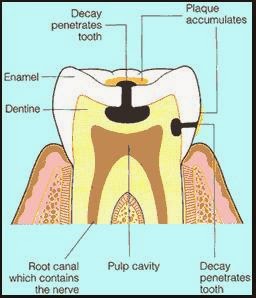
Usually, dental decay is fairly easy to detect. When a cavity is just beginning, it is typically identified by a brown or white color or a change in the translucency of the enamel of the tooth. The dentist or dental hygienist uses a special dental instrument called an explorer to feel the suspect area and check its hardness. If the area is hard, in other words, if no break in the enamel layer is detected, we feel there is not a cavity present. If, however, the surface feels soft and the explorer "sticks" in the suspect site, we feel a cavity is present.

Fluoride makes our enamel stronger, but dentin decay is harder to detect Because of the widespread use and availability of fluoride in our drinking water, foods, and oral care products, we are seeing a different decay pattern. The appearance is different from the typical pattern of decay and more difficult to detect. As the outer surface of the enamel absorbs fluoride (from toothpaste, for example), the enamel becomes very resistant to demineralization and eventual decay. If there is a small break in the integrity of the enamel, a pit or groove where decay-causing bacteria can live, the bacteria can dissolve the enamel in such a way that the hole in the enamel cannot be detected. Once the decay-causing bacteria reach the underlying dentin, the acids eat away at that substance and quickly make a large cavity - but one that still cannot be easily seen or detected. In this way the enamel becomes undermined. A dentist looking at such a small cavity would think it very easy to restore. However, once the decayed portion of the enamel is removed and the dentin becomes visible, the true extent of the damage becomes obvious. The small cavity becomes a big cavity.

One of the major problems with decay that appears to occur only in the dentin is in the detection. If a radiograph is taken a part of the periodic examination process, we may be able to see dentin decay if it is moderate to extensive. Decay seen on radiographs is typically two to seven times greater in the tooth. Modern high-speed radiographic film and reduced x-ray exposure makes it more difficult to detect early decay on radiographs.

You can prevent decay by using fluoride
The conscientious application of a source of topical fluoride, through either an over-the-counter dentifrice or a prescription fluoride product, and thorough plaque removal are essential. Bonded sealants are also an effective protection against dentin decay. We strongly advice these procedures. Periodic examinations at intervals recommended by the dentist catch decay at the earliest possible time. This is the only way to keep small problems from developing into larger problems.

Click here to check out our blog post on foods that cause decay. 
Click here for our post on how to prevent decay.

If you have any questions about dentin decay, please feel free to ask us. 

Tuesday, July 15, 2014

Prevention of Decay

What is dental decay, and how do dentists fix it?
Dental caries (decay) is a bacterial infection, first of the enamel, then of the dentin of the tooth. The tradition in dentistry has been to surgically remove the diseased portion of the tooth by "drilling" out the decay and then filling the resulting hole in the tooth with some inert material. As most adults know, this procedure will be performed over and over again when new decay begins or when the filling (often silver) breaks or the tooth fractures.

Click here to learn about decay in young children.

Why should I practice prevention?
Would it not be better to eliminate the cause of the infection and thus not be forced to have big holes drilled in the teeth? We believe the bacterial cause of the infection should be addressed.

How do I prevent dental decay?
There are several positive steps that you can take to reduce your risk of dental decay. 

A. At the dentist's office
1. First, all the active decay in your mouth should be treated immediately. 

2. Next, all teeth that would benefit from sealants should be treated. 
  • Why? This will prevent bacteria from reaching into the pits, fissures, and grooves that normally exist on the occlusal (biting) surfaces of teeth. Any stray bacteria that may still be in the sealed area are effectively cut off from their source of food and become inactive. Although sealants are most effective on teeth that have not been previously restored, they can be successfully placed on teeth filled with bonded fillings.
3. The infection can be treated with antimicrobials. 

4. We believe that the use of a fluoridated mouthrinse twice daily or use of a prescription fluoridated dentifrice as directed provides a great advantage. 
5. We may also prescribe a chlorhexidine mouthrinse, an antimicrobial oral rinse that has a great effect on Streptococcus mutans.

B. In your daily life
6. Your diet and oral self-care are important in dental decay prevention. When you eat junk food and drink sugary liquids, your teeth are more prone to decay. The more frequently you snack, the more prone your teeth will be to decay. 

7. If your brushing and flossing are not effective, your teeth will be more prone to decay. When you can't brush after a meal, at least rinse your mouth with water within 15 minutes to dilute the acids forming from the ingested food or drink. 

8. If you have a diminished salivary flow, take frequent sips of water during the day to help dilute the acids produced by the bacteria.

What if decay keeps coming back?
If you have a continuing problem with active decay, we recommend more frequent preventive recare appointments. It has been repeatedly shown that patients who have good oral self-care and maintain a recare interval of 3 to 4 months have many fewer dentally related (cavities or gum disease) problems.

Present-day dental suggestions are based on proven scientific information. You might need to have your teeth cleaned by the hygienist twice each year, or you may need to be seen more frequently. 

For certain individuals, we also suggest testing the oral bacterial levels to determine the magnitude and presence of a Streptococcus mutans infection and to determine your risk level for future dental disease.

If you have any questions about the prevention of dental decay, please feel free to ask us.