Showing posts with label sealants. Show all posts

Friday, January 27, 2017

Sealants and Fluoride: Benefit to Adult Patients

Dental decay can develop at any time, regardless of a person’s age. A change in diet, change in lifestyle, change in oral self-care habits, the use of prescription medications, or a change in systemic health due to the normal aging process can all affect the caries (decay) susceptibility. Few people remain completely free of decay. Proper oral self-care on your part and properly spaced dental hygiene prevention appointments will go a long way to reduce the opportunity to have new decay begin.
As you age, it is possible that some of your gum tissue will recede, exposing the root surfaces of your teeth. This gum recession can occur from improper brushing (brushing too hard with a hard toothbrush) or as a result of past periodontal problems. The more a tooth and root are exposed, the greater is the surface area you will have to keep clean. Sometimes the teeth with exposed roots are very hard to keep clean. These roots may be sensitive to temperature changes and are often times uncomfortable to brush. Decreased salivary flow helps to create a breeding ground for bacteria to accumulate on the enamel and especially on the root surface. And root decay usually progresses quite quickly!

Goal of Prevention
Your goal should be to keep the dentist from drilling your teeth. Any reasonable preventative measure that is available should be seriously considered. When the dentist drills, you lose. When the dentist does not drill, you win,

Dental Sealants
Although sealants are primarily designed for children, adults who have a history of active decay should consider having sealants placed on the posterior (back) teeth where indicated. We will tell you where it is possible to place the sealants. Even if you have not had a cavity for a long time, consider the application of a sealant as an inexpensive insurance policy for your teeth. Perhaps you would never get decay on the unsealed surfaces. But, just as you insure your home against destruction by fire, a sealant insures the tooth surface from decay. Preventative measures may allow you to avoid having your teeth drilled. You win!  

Topical Fluoride
For a similar reason, we advise the use of topical fluoride treatments for adults. The effectiveness of systemic and topical fluoride in preventing decay is well documented. When a cavity first starts, an application of fluoride might (depending on when it is used) reduce or eliminate the need for drilling.
An alternative to the fluoride treatment we can provide in our office is a daily rinse. If you can rinse with an over-the-counter mouthrinse containing fluoride every night as directed on the rinse label, you do not need the office topical fluoride treatment. If you cannot rinse daily as instructed, you will need the benefit from a stronger office-applied topical fluoride treatment. Your oral health will benefit most from small increments of fluoride that are applied daily rather than one large concentration every 6 months. However, only you know whether you will be faithful to your rinsing routine. When in doubt, let us do it here.

If you have been a patient of Omni Dental Group, you know that we stress prevention of dental disease above all else. Sealants and topical fluoride treatments are two of the more preventative dental measures that we believe will significantly enhance your oral health. 

Monday, November 7, 2016

Dental Sealants Prevent Cavities and More Kids Need Them, CDC Says

There's a quick and easy way to prevent 80 percent of cavities, but most kids don't get it, federal health officials said Tuesday. The treatment, dental sealants, works well, but only 60 percent of kids who need sealants get them, the Centers for Disease Control and Prevention says.
                       
    
Dentist inspecting boys mouth before treatment. Universal Images Group / UIG via Getty Images

One good solution: doing it at school. But states often lack the funding to pay for such programs, and often bureaucratic requirements about having dentists on site can hold them up, also, the CDC said.

"Many children with untreated cavities will have difficulty eating, speaking, and learning," said CDC director Dr. Tom Frieden.

"Dental sealants can be an effective and inexpensive way to prevent cavities, yet only one in three low-income children currently receive them. School-based sealant programs are an effective way to get sealants to children."
The CDC says that 20 percent of kids and teenagers have untreated dental decay by the time they are 19. Kids with constant toothaches cannot eat properly and have trouble paying attention at school.

Related: Do Kids Need Dental Sealants?

Even though they are endorsed by the CDC and the American Dental Association, only 43 percent of 6- to 11-year-old children have a dental sealant, federal surveys show.

"Low-income children were 20 percent less likely to have sealants than higher-income children," the CDC's Susan Griffin and colleagues wrote in a report released Tuesday.                    

"School-age children without sealants have almost three times more cavities than children with sealants," the CDC added.

"Applying sealants in school-based programs to the nearly 7 million low-income children who don't have them could save up to $300 million in dental treatment costs."

That's because a filling costs more. In addition, once a tooth has been drilled to put in a filling, it's never as stable again.
But many states struggle to pay for such programs, the CDC team found.

"Federal funding of state oral health programs is largely com­petitive and varies widely by state," they wrote. "Many state and local school-based sealant programs cover part of their expenses by Medicaid billing."

And Medicaid, the joint state-federal health insurance plan for children and low-income people, is already badly stretched in most states.
One big expense is paying a dentist to oversee the program, the CDC found. One solution: Allow lower-paid professionals to administer sealant programs. At least one state has already done so.

"For example, in South Carolina, school-based sealant programs managed and staffed by dental hygienists deliver sealants in approximately 40 percent of high-need schools," Griffin and colleagues wrote.

"CDC currently provides funding to 21 state public health departments to coordinate and implement school-based and school-linked sealant programs that target low-income children and those who live in rural settings," the agency added.

It said the federal government plans to do more. It will classify pediatric dental services as an essential health benefit to be covered by dental insurance as part of the Affordable Care Act, for instance, and match state Medicaid and CHIP costs for sealants.
The sealants are plastic-based coatings that get into the cracks and crannies of molar teeth, stopping food and bacteria from starting the chemical reaction that leads to cavities.
 Studies show they are safe and stop tooth decay, even when they are layered over an existing pre-cavity.

"Studies on sealant effectiveness indicate that sealants delivered in clinical or school settings prevent about 81 percent of decay at two years after placement, 50 percent at four years, and can continue to be effective for up to nine years through adolescence," the CDC said.

 The American Dental Association (ADA) agrees, and says many people don't know that dental insurance often pays for them.

"Dental sealants are one-third the cost of a filling, so their use can save patients, families, and states money," the Pew Charitable Trusts, an independent, public service-oriented nonprofit, says in a statement. "Sealant programs based in schools are an optimal way to reach children — especially low-income children who have trouble accessing dental care."
 One worry that parents may have is about BPA, a chemical found in the sealants that is increasingly linked with health risks. The ADA says the benefits of sealants far outweigh any perceived risk.

"The potential amount of BPA patients could be exposed to when receiving sealants is minuscule, and it's less than the amount a person receives from breathing air or handling a receipt," the ADA says.

By: Maggie Fox, NBC News
http://www.nbcnews.com/health/kids-health/dental-sealants-prevent-cavities-more-kids-need-them-cdc-says-n668266

If you have questions or would like to schedule an appointment, please contact Omni Dental Group at one of our three office locations listed below:

North Austin on Hymeadow Drive: (512) 250-5012
Central Austin on Jollyville Road: (512) 346-8424
South Austin on William Cannon: (512) 445-5811

Friday, October 14, 2016

5 Dental Health Tips On How To Protect Your Teeth From The Cold

It is a fact that the healthy teeth are the factor with the greatest influence on anyone’s confidence. This is why we pay so much attention to our teeth. As we are slowly entering autumn the weather is gradually changing for the worse. Also, the temperature is dropping slowly and in couple of months it is going to be freezing outside.
Did you know that cold weather may leave you prone to some of the dental problems?
Some of us have sensitive teeth which certainly becomes annoying during winter season. This is the time of the year when sudden change in temperature is pretty common. It can cause either sharp, unsettling pain or mild discomfort in your teeth.
Here are some dental health tips that could help you protect your teeth from cold.

Visit the Expert

If you haven’t checked your teeth recently, you might consider visiting an expert. This type of dental medical center offers all kinds of services to their patients, kind of like a Perfect Smile Spa. Your teeth may be simply sensitive to cold weather because they are cracked or have enamel which is either weakened or thin. Other reasons for cold weather sensitivity may be gum recession, brushing too hard, infection, gingivitis and clenching or grinding teeth.
A professional at perfect smile spa will be able to determine what course of action will have the best result for your teeth, after they have previously examined you. This is the only way to ensure that you have strong and healthy teeth. After you have taken care of this, you can try the following tips on how to reduce your teeth’s cold sensitivity.

Practice Proper Oral Hygiene

Cold tooth sensitivity can be fixed at home fairly easily. You just have to step up your oral hygiene game. Make sure to brush your teeth after meals and don’t forget to floss. If you are still experiencing pain after rapid temperature changes, you might want to try changing your toothpaste.
For instance, potassium based desensitizing toothpaste is a great way to help reduce the sensitivity in your teeth. If you know that you have this problem you should use this toothpaste at least a month before the temperature drops, because it takes time for it to work. It depolarizes areas of exposed dentin or root, which is why it takes time to reach full effect, but when it does, trust me, you can say goodbye to cold sensitivity.
Another great choice is calcium based desensitizing toothpaste. It provides immediate relief by plugging open pores encasing the tooth calcium. It mimics the body’s natural ways of remineralization, thus protecting the sensitive nerve endings in your teeth. Also, make sure that you are using a toothbrush with soft bristles.

Maintain your Water Intake

Staying hydrated during winter is as important as it is during the hot summer months. Don’t forget this! The experts recommend at least 2 liters of water per day. This will not only keep your brain and body healthy but also your teeth. Proper water intake will ensure that your gums and teeth are moist. Also, by drinking enough water, you will produce more saliva. This is important, especially during cold months since it is known that saliva is more prone to drying up in cold weather. Without enough saliva, bacteria build up exponentially in our mouth.
Try to avoid sugary beverages as they are not a good way to stay hydrated and sugar helps bacteria reproduce. Stick to water, and of course your favorite tea. Furthermore, if your teeth are sensitive to cold you should avoid consuming acidic foods as this can also contribute to or aggravate their sensitivity.

Limit Time Spent Outdoor

If it is freezing outside and you know that your teeth are sensitive to cold, you have to limit your time spent outdoors. The ability to see your own breath is a sign that you should be heading to a cozy warm room as soon as you can.
Like any other material, the material our teeth are made of expands and contracts when temperature rises or drops. This is why sudden changes of temperature can cause small surface hairline fractures on our teeth. These lead to teeth that are hyper sensitive to temperature change.
In case you have to go outside to do your errand make sure to wear some sort of scarf, so that it can trap warmth around your mouth.

Adjust your Diet

Your diet has everything to do with your dental health, as it has to do with your overall health. I have already mentioned that you should avoid acidic foods, but let’s dive into some more specifics.
It is not only important to look after what you eat, but also when you eat it. Getting onto a healthy diet will help you straighten your defenses against cold weather. Before you decide to go onto any dieting regime, make sure to consult a physician. Keep his advice in mind when you are choosing your foods.
In general, you can pick meals and snacks from the following food groups: vegetables, fruits, whole grains, lean beef, skinless poultry and fish, dry beans and peas, fat-free or low-fat dairy products.
It is of great importance that you limit the number of snacks. This is because having snacks can be far more dangerous for your teeth than regular meals. You may wonder why? Well, because there is more saliva during regular meals, and it successfully washes away foods from the mouth and reduces the effects of the acids.
While enjoying snacks, there is far less saliva. The acidic environment in your mouth can harm your teeth and cause cavities.
I really hope these tips will help you protect your teeth from the cold. Expanding your knowledge on this topic through some additional online research is a great way for covering all of your bases. In the end, remember this little gem of wisdom: “Dentistry is not expensive, neglect is.”

By: Rhais Saifi, Huffigton Post
http://www.huffingtonpost.com/rahis-saifi/5-dental-health-tips-on-h_b_12457368.html
 
If you have questions or would like to schedule an appointment, please contact Omni Dental Group at one of our three office locations listed below:

North Austin on Hymeadow Drive: (512) 250-5012
Central Austin on Jollyville Road: (512) 346-8424
South Austin on William Cannon: (512) 445-5811

Monday, August 4, 2014

Dentin Decay

Detect decay by inspecting the color and hardness
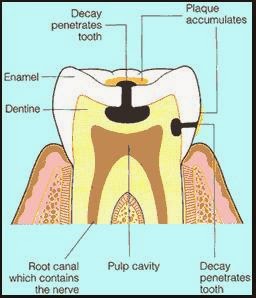
Usually, dental decay is fairly easy to detect. When a cavity is just beginning, it is typically identified by a brown or white color or a change in the translucency of the enamel of the tooth. The dentist or dental hygienist uses a special dental instrument called an explorer to feel the suspect area and check its hardness. If the area is hard, in other words, if no break in the enamel layer is detected, we feel there is not a cavity present. If, however, the surface feels soft and the explorer "sticks" in the suspect site, we feel a cavity is present.

Fluoride makes our enamel stronger, but dentin decay is harder to detect Because of the widespread use and availability of fluoride in our drinking water, foods, and oral care products, we are seeing a different decay pattern. The appearance is different from the typical pattern of decay and more difficult to detect. As the outer surface of the enamel absorbs fluoride (from toothpaste, for example), the enamel becomes very resistant to demineralization and eventual decay. If there is a small break in the integrity of the enamel, a pit or groove where decay-causing bacteria can live, the bacteria can dissolve the enamel in such a way that the hole in the enamel cannot be detected. Once the decay-causing bacteria reach the underlying dentin, the acids eat away at that substance and quickly make a large cavity - but one that still cannot be easily seen or detected. In this way the enamel becomes undermined. A dentist looking at such a small cavity would think it very easy to restore. However, once the decayed portion of the enamel is removed and the dentin becomes visible, the true extent of the damage becomes obvious. The small cavity becomes a big cavity.

One of the major problems with decay that appears to occur only in the dentin is in the detection. If a radiograph is taken a part of the periodic examination process, we may be able to see dentin decay if it is moderate to extensive. Decay seen on radiographs is typically two to seven times greater in the tooth. Modern high-speed radiographic film and reduced x-ray exposure makes it more difficult to detect early decay on radiographs.

You can prevent decay by using fluoride
The conscientious application of a source of topical fluoride, through either an over-the-counter dentifrice or a prescription fluoride product, and thorough plaque removal are essential. Bonded sealants are also an effective protection against dentin decay. We strongly advice these procedures. Periodic examinations at intervals recommended by the dentist catch decay at the earliest possible time. This is the only way to keep small problems from developing into larger problems.

Click here to check out our blog post on foods that cause decay. 
Click here for our post on how to prevent decay.

If you have any questions about dentin decay, please feel free to ask us. 

Wednesday, July 30, 2014

Sealants and Fluoride: Benefit to Adult Patients

Dental decay can develop at any time, regardless of a person's age. A change in diet, change in lifestyle, change in oral self-care habits, the use of prescription medications, or a change in systemic health due to the normal aging process can all affect the caries (decay) susceptibility. Few people remain completely free of decay. Proper oral self-care on your part and properly spaced dental hygiene prevention appointments will go a long way to reduce the opportunity to have new decay to begin.

As you age, it is possible that some of your gum tissue will recede, exposing the root surfaces of your teeth. This gum recession can occur from improper brushing (brushing too hard with a hard toothbrush) or as a result of past periodontal problems. The more a tooth and root are exposed, the greater is the surface area you will have to keep clean. Sometimes the teeth with exposed roots are very hard to keep clean. These roots may be sensitive to temperature changes and are often times uncomfortable to brush. Decreased salivary flow (dry mouth) helps to create a breeding ground for bacteria to accumulate on the enamel and especially on the root surface. And root decay usually progresses quite quickly!

Goal of Prevention
Your goal should be to keep the dentist from drilling your teeth. Any reasonable preventive measure that is available should be seriously considered. When the dentist drills, you lose. When the dentist does not drill, you win.
                               
                                                         Dental Sealants
Please see our blog post on sealants. Although sealants are primarily designed for children, adults who have a history of active decay should consider having sealants placed on the posterior (back) teeth where indicated. We will tell you where it is possible to place the sealants. Even if you have not had a cavity for a long time, consider the application of a sealant as an inexpensive insurance policy for your teeth. Perhaps you would never get decay on the unsealed surfaces. But, just as you insure your home against destruction by fire, a sealant insures the tooth surface from decay. Preventive measures may allow you to avoid having your teeth drilled. You win! 

Topical Fluoride
For a similar reason, we advise the use of topical fluoride treatments for adults. The effectiveness of systemic and topical fluoride in preventing decay is well documented. When a cavity first starts, an application of fluoride might (depending on when it is used) reduce or eliminate the need for drilling.
Fluoride Varnish

An alternative to the fluoride treatment we can provide in our office is a daily rinse. If you can rinse with an over-the-counter mouth rinse containing fluoride every night as directed on the rinse label, you do not need the office topical fluoride treatment. If you cannot rinse daily as instructed, you will need the benefit from the strong office-applied topical fluoride treatment. Your oral health will benefit most from small increments of fluoride that are applied daily rather than one larger concentration every 6 months. However, only you know whether you will be faithful in your rinsing routine. When in doubt, let us do it here.

We stress prevention of dental disease above all else. Sealants and topical fluoride treatments are two of the more important preventive dental measures that we believe will significantly enhance your oral health.

Tuesday, July 29, 2014

Seal the Deal: Everything You Need To Know About Sealants

What are dental sealants?  

Dental sealants represent one of the greatest advances in modern dentistry. Unfortunately, too many children do not receive the protective benefits of dental sealants. Dental sealants are clear protective coatings that are easily applied; they cover the tooth surface, preventing bacteria and food particles from settling into the pits and fissures (grooves) of the teeth. It is a thin coat of plastic that is painted on the surface of teeth, usually the premolars and molars in order to prevent caries.

Decay on back teeth, premolars, and molars usually begins in the grooves and fissures that normally exist on the biting surfaces of the back teeth.  Dental sealants, available since the 1960s, are clear plastic coatings that can be placed on the biting and grinding surfaces of posterior teeth.  These sealants prevent the formation of decay on the treated surfaces.  Sealants can even be placed of teeth with small areas of decay known as incipient carious lesions.  The sealants will stop the customary progress of tooth destruction.  

Effectiveness
It can remain on the tooth from 3 to more than 20 years, depending on the tooth, type of sealant used, and the eating habits of the patient.  It can only be placed on teeth that have not been previously restored.
It is well known that the use of fluoride increases the resistance of enamel to decay. Unfortunately, the pits and fissures of the teeth do not benefit from the effects of fluoride as greatly as smooth enamel surfaces do. Scientific studies have proved that properly placed dental sealants are 100% effective in protecting development of cavities in sealed tooth surfaces. 

Why sealants are necessary
The narrow width and uneven depth of pits and fissures make them ideal places for the accumulation of food and acid-producing bacteria. Saliva, which helps to remove food particles from other areas of the mouth, cannot clean deep pits and fissures. Pits and fissures on the teeth are so tiny that even a single toothbrush bristle is too large to enter for cleaning purposes. Another difficulty associated with deep pits and fissures is that the enamel that lies at the base of the fissures is thinner than the enamel around the rest of the tooth. This means that not only can deep narrow fissures make it more likely that tooth decay will occur, but any decay that does form will penetrate through the thin enamel and progress more quickly into the pulp.

We, at this office, are dedicated to the prevention of oral disease.  It is clear that if the initial decay is prevented from beginning or is small enough to use a sealant, there is a great savings in time, money, discomfort, and tooth structure.  Decayed teeth must have the decay removed by drilling, then they must be filled.  This drill and fill may have to be done several times over the patient's lifetime as the filling ages and needs replacement.  We strongly suggest that patients who have teeth that can be successfully protected with a sealant material consider having this procedure performed as soon as possible.


How sealants work
The sealant acts as a physical barrier that prevents decay. Small food particles and plaque (bacteria) cannot penetrate through or around a sealant. As long as the sealant remains intact, the tooth is protected. However, if part of the sealant or bond is broken, the sealant protection is lost. 

A study completed in 1991 found that one application of sealant reduced biting surface decay 52% over a 15-year period.  Another study, completed in 1990, showed that decay on biting surfaces could be reduced 95% over 10 years if 2% to 4% of the sealants were routinely repaired each year.  We expect sealants to last many years. After a sealant is applied it can last up to ten years, however regular check-ups are recommended since they can chip or wear off. Replacing or repairing sealants, as needed, on an ongoing basis will give the best protection. 

A sealant is not meant as a substitute for proper brushing and flossing habits. The effectiveness of the sealant is reduced if oral self-care is neglected. Also, cavities can still form on untreated surfaces. Therefore, a topical fluoride treatment remains an essential and necessary preventative aid.

Application of sealants
The sealant is placed on the tooth through a chemical/mechanical bonding procedure.  There is not drilling or local anesthesia required for the sealant application procedure.  It is entirely painless.

Problems with sealants
On occasion, teeth with very small initial carious lesions may be inadvertently sealed, or some bacteria may remain beneath the sealant. It was one believed that if this were to occur, decay would develop under the sealant. However, numerous studies have shown that this does not occur. Bacteria cannot survive beneath a properly placed sealant because the carbohydrates that they need to survive cannot reach them. Studies have shown that the number of bacteria in small, existing carious lesions that had been sealed actually decreased dramatically over time. The most important factor is that the sealant must be properly placed.

When sealants are used
Sealants are used primarily on children, but in certain circumstances, adults also can benefit from their use. Children and teenagers are the best candidates for sealants. Children are prone to caries from age 6-14 and applying a sealant as soon as a child’s permanent molars and premolars erupt can be a great way to protect your child from tooth decay. Some maxillary central and lateral incisors may have deep pits that could be protected by sealants. Sealants are indicated for teeth with deep pits and fissures, preferably in recently erupted teeth (i.e., within previous 4 years). Sealants should be used as part of a prevention program that includes the use of fluorides, dietary considerations, plaque control, and regular dental examinations.

We especially advise that children have the sealant applied to their teeth as soon as the teeth break through the gum and the biting surfaces of the teeth are no longer covered with gum tissue.  If the teeth cannot be totally isolated from the moisture in the mouth during the bonding process, it is likely that the sealant will not remain on the tooth for as long a period of time as expected.  The sealant is most often applied to permanent teeth, but sometimes a situation arises in which it would be beneficial to have the sealant applied to a primary tooth.

In both 1984 and 1994, sealants have been recommended by the U.S. Public Health Services and Surgeon General of the United States, among others. We know that sealants are one of the most important treatments available for prevention of dental decay.

If you have any questions about sealants, please feel free to ask us.

Tuesday, July 15, 2014

Prevention of Decay

What is dental decay, and how do dentists fix it?
Dental caries (decay) is a bacterial infection, first of the enamel, then of the dentin of the tooth. The tradition in dentistry has been to surgically remove the diseased portion of the tooth by "drilling" out the decay and then filling the resulting hole in the tooth with some inert material. As most adults know, this procedure will be performed over and over again when new decay begins or when the filling (often silver) breaks or the tooth fractures.

Click here to learn about decay in young children.

Why should I practice prevention?
Would it not be better to eliminate the cause of the infection and thus not be forced to have big holes drilled in the teeth? We believe the bacterial cause of the infection should be addressed.

How do I prevent dental decay?
There are several positive steps that you can take to reduce your risk of dental decay. 

A. At the dentist's office
1. First, all the active decay in your mouth should be treated immediately. 

2. Next, all teeth that would benefit from sealants should be treated. 
  • Why? This will prevent bacteria from reaching into the pits, fissures, and grooves that normally exist on the occlusal (biting) surfaces of teeth. Any stray bacteria that may still be in the sealed area are effectively cut off from their source of food and become inactive. Although sealants are most effective on teeth that have not been previously restored, they can be successfully placed on teeth filled with bonded fillings.
3. The infection can be treated with antimicrobials. 

4. We believe that the use of a fluoridated mouthrinse twice daily or use of a prescription fluoridated dentifrice as directed provides a great advantage. 
5. We may also prescribe a chlorhexidine mouthrinse, an antimicrobial oral rinse that has a great effect on Streptococcus mutans.

B. In your daily life
6. Your diet and oral self-care are important in dental decay prevention. When you eat junk food and drink sugary liquids, your teeth are more prone to decay. The more frequently you snack, the more prone your teeth will be to decay. 

7. If your brushing and flossing are not effective, your teeth will be more prone to decay. When you can't brush after a meal, at least rinse your mouth with water within 15 minutes to dilute the acids forming from the ingested food or drink. 

8. If you have a diminished salivary flow, take frequent sips of water during the day to help dilute the acids produced by the bacteria.

What if decay keeps coming back?
If you have a continuing problem with active decay, we recommend more frequent preventive recare appointments. It has been repeatedly shown that patients who have good oral self-care and maintain a recare interval of 3 to 4 months have many fewer dentally related (cavities or gum disease) problems.

Present-day dental suggestions are based on proven scientific information. You might need to have your teeth cleaned by the hygienist twice each year, or you may need to be seen more frequently. 

For certain individuals, we also suggest testing the oral bacterial levels to determine the magnitude and presence of a Streptococcus mutans infection and to determine your risk level for future dental disease.

If you have any questions about the prevention of dental decay, please feel free to ask us.