Showing posts with label cosmetic. Show all posts

Friday, February 17, 2017

You Can Have Whiter Teeth!

The least damaging and most conservative way of making your teeth lighter is with the use of a whitening solution. Contrary to what you might think, brushing your teeth harder with an abrasive toothbrush will not make your teeth whiter, but rather may darken them faster. The tooth-whitening concept has been around for many years, and the techniques have become easier and less expensive to accomplish. Tooth whitening was noted in the dental literature in the 1920s. the technique has become easier and the cost has decreased. Today, there are two convenient methods to whiten dark teeth: At-Home Whitening and In-Office Whitening.

Why Do Teeth Get Yellow?
The intrinsic color of your teeth is related to the color and thickness of the enamel and dentin, as well as the types of foods and liquids you ingest. The thinner the enamel, the darker the underlying dentin; the more coffee, tea, cola beverages, and red wine you drink, the darker your teeth will be. Cracks that are commonly found in the enamel of your teeth may provide a pathway for discoloring fluids to reach the underlying dentin.
If you have a yellow, brown, or orange shade to your teeth, in most cases it can be made lighter by the whitening procedure. Whitening works very well in removing age-related darkening of your teeth. This age-related darkening is most likely due to years of drinking darkening beverages, or other environmental factors, rather than genetics. No drilling or anesthesia is required for whitening. Your teeth will not become weaker. Because the mineralization of teeth varies so much from person to person, there is no way to determine how many office visits it will take to effect the color change or how white the teeth will get. The darker your teeth are, the more time required for the change and the more distinctive the color change will be.
The whitening procedure will also work to a lesser degree on teeth with tetracycline discoloration. We have seen several fair to good results from both in-office and at-home whitening. It does take more time to achieve good results on this type of stain, and unfortunately, sometimes the change is minor.

Two Available Techniques
There are two types of whitening available. One is done by the patient at home, and the other is done by us during an office visit. They can be done separately or in conjunction with each other. The at-home technique involves using a soft, thin, comfortable mouthguard-like tray. An impression is made of your teeth, and custom whitening trays are fabricated. Then at home, you place the whitening solution in the trays and wear them for an hour or two each day or sleep with them in place at night. With in-office whitening, you come to the office for 1 to 2 hours, and a stronger whitening solution is applied by us and activated for that time. Usually only one visit is required.

The color change should last for 3 to 7 years in most people. The color change you see immediately after the whitening is completed will regress one shade over the course of 1 to 3 months, with most of the change taking place in the first week. If you drink a lot of coffee, tea, cola beverages, red wine, or if you smoke, the teeth may begin to turn darker again. When this happens, the whitening process can be repeated.
The possible side effects include temporary white discoloration of the gum tissue if the office whitening solution comes in contact with the gum. This goes away quickly. The teeth may become slightly sensitive to temperature changes for a short time. This also goes away quickly. There is no damage to the tooth enamel, dentin, or pulp from the whitening process. Fillings and crowns do not whiten. When your teeth change to a lighter color, you may need to have those fillings and/or crowns redone. We will let you know whether this is a possibility before we whiten your teeth. There are no other adverse effects known.
The teeth that show when you talk, smile, or eat are the teeth that would benefit your appearance most if whitened. Usually the top teeth are whitened because they are much more visible than the bottom teeth, but both arches can be successfully whitened. The lower teeth take about three times as long to reach the color change of the top teeth.

If you have any questions about enamel recontouring, please feel free to ask us!  
Hymeadow: (512) 250-5012
Jollyville: (512) 346-8424
West William Cannon: (512) 445-5721


Enamel Recontouring


Most people want straight, beautifully aligned, white teeth. Unfortunately, most people are not that lucky. When teeth are in poor alignment, rotated, tilted, and/or crowded, the obvious way to correct the problem is by orthodontics (braces or Invisalign aligners). However, there are situations in which it may not be possible or desirable to use braces to straighten teeth. You might feel that you are too old (although this is rarely the case), the cost of the orthodontics may be beyond your current means, you may not want to wear braces, or perhaps there are only a few areas that need attention and full orthodontics are simply not indicated.

In certain select cases, the appearance of your top and bottom teeth can be slightly or dramatically improved by recontouring the enamel. The four top and four bottom incisors and canines can be routinely altered. Sometimes teeth further back in your mouth can also be cosmetically improved. Recontouring is useful when there is slight to moderate overlapping of the front teeth, uneven wear, or teeth that do not have their biting and incising edges in harmony, creating an uneven “picket fence” look.
Enamel recontouring is usually a painless procedure and no local anesthetic is needed. The enamel that is overlapping or poorly shaped is removed, recontoured, and polished. Depending on your individual needs, one or several teeth may require some reshaping. Different amounts of enamel may be removed from different teeth. The recontoured teeth do not become more prone to decay, are not made more sensitive to temperature changes, and they are not made significantly weaker or damaged by the procedure.
Many times, the recontouring is all that is necessary to significantly improve your appearance. Other times, when the poor alignment is more pronounced, it may be done in conjunction with bonding of resin or porcelain to teeth. Your treatment will depend on your present conditions and on what you would like to see changed.


The procedure is not difficult for the patient and can often be done in only one appointment. The change is immediate and permanent. It does take an artistic flair on the part of the dentist to see what possibilities for change exist. We need to determine what enamel needs to be removed, where we must add, and where orthodontics is the treatment of choice. The fees are reasonable and depend on the extent of the treatment.

If you have any questions about enamel recontouring, please feel free to ask us!  
Hymeadow: (512) 250-5012
Jollyville: (512) 346-8424
West William Cannon: (512) 445-5721

Cosmetic Tissue Recontouring

It is not uncommon for us to suggest to a patient who has absolutely no sign of periodontal (gum) disease to seriously consider having elective periodontal procedures performed. In these cases, the procedures are almost always needed to improve appearance. Sometimes they are suggested to promote future periodontal health or to attend to a potential problem that might develop.

When you smile or talk, your teeth are framed by your lips and the visible gum tissue. People looking at you notice your teeth. People notice missing teeth, tooth alignment, gum color, discolored fillings, silver fillings, toot color, and how much of your teeth actually show. If everything is integrated well and looks natural, people say you have a nice smile. If something does not look natural, it may be easy to define, such as crooked, stained or yellow teeth; periodontal disease shown by red-colored gum tissue; or discolored fillings. Or it may be something not as readily to determine. It’s just something that does not look right.

That “something” may be related to the teeth and gum architecture. The position of the gums where they meet the teeth is esthetically important. If your teeth look too short, there may be more gum tissue covering them than is considered attractive. You may show too much gum tissue when you smile. There may be a difference in height of the gum of one tooth versus an adjacent tooth or its partner on the other side of the mouth. This could be caused by recession from brushing too hard; gum disease; poor or defective restorations, especially crowns; or just a problem with the way the tooth erupted into place. All of these things can detract from your appearance.

Several different periodontal procedures, simple to accomplish, can correct most of these routine problems. Some involve removal of unwanted tissue; some involve grafting of tissue. Orthodontics might be helpful in some cases. The more expensive procedures will require referral to our specialists.
In one common type of cosmetic periodontal plastic surgery, the gum tissue is reshaped and recontoured without the use of sutures (stitches). This procedure is done in the office. One tooth or several teeth may benefit from treatment. Postoperative discomfort is usually minor. There may be tooth sensitivity when gum tissue is removed, but this usually disappears. The improvement generated by this type of procedure can be startling.


We will show you and describe in detail how you can benefit from cosmetic periodontal procedures. In many cases, the cosmetic periodontal surgery will complete the treatment you need. In some cases, it will be part of a larger treatment plan including crowns, veneers, or bonded restorations. 

If you have any questions about cosmetic tissue recontouring, please feel free to ask us!  
Hymeadow: (512) 250-5012
Jollyville: (512) 346-8424
West William Cannon: (512) 445-5721

Monday, February 6, 2017

Altered Passive Eruption: Hard Tissue


Teeth are composed of two basic, visible parts—the root portion and the crown (enamel-covered) portion. The term crown does not refer to the type of tooth replacement fabricated by a dental laboratory. Rather, it is the part of the tooth that is normally seen when you speak.

The present-day esthetic dental philosophy, demonstrated by people who have beautiful teeth and smiles, shows that there must be a certain amount of enamel-covered tooth visible for an attractive smile. The ratio is about 1.6:1, length to width. Teeth that are shorter than this look progressively less attractive. They look short and stubby. If they are actually worn down from a clenching or grinding problem, this is a different type of problem. But it may not be that the teeth themselves are too short. It could be that there is not enough of the crown of the tooth that can be seen. The remainder that should be seen is covered with gum or gum and bone tissue. This is known as altered passive eruption. It is not entirely clear why this happens. It may become obvious as early as age 14. The teeth may have a pleasing color and be very straight, but they still leave something to be desired because they are too small and too much gum shows when you smile.

This can be a severe cosmetic problem when coupled with the type of lip line that frames the teeth. A low lip line will probably hide most or all of the gum covered part of the tooth, so there is less of a need to correct the defect. A medium or high lip line, especially a high lip line, will show all of the tooth and gum. As the lip line gets higher, the attractiveness of the smile goes down. The situation can be so severe that the patient will train his or her muscles to artificially hold the upper lip stiff or cover the mouth with a hand when smiling. In this way, the short teeth or the great expanse of gum tissue will be hidden from view. It can cause significant psychological problems.

The solution can be easy or complicated, depending on the exact nature of the problem. If there is only a small amount of gum tissue to be removed from a single tooth or multiple teeth, and there is a medium lip line, then the tissue is easily removed with a laser or electrosurgical cutting device. Scalpels and stitches are not needed in small cases. As more gum must be removed and more tooth is exposed, there may be some underlying bone that must be reshaped. Bone removal will be followed, about 2 months later, by the soft tissue removal mentioned earlier. The first surgery must heal long enough for the tissue to reach its final position before the second can be completed. Remember, you are looking at differences of several millimeters to a fraction of a millimeter that will cause the case to be a success or failure. A two-step procedure is better than a one-step procedure.

The biting edges (enamel and/or dentin) of one or more teeth may be reshaped if there is a need not only to lengthen the teeth but also to make it appear that they have actually been placed higher in the smile line. This is for top teeth, of course. If a great deal of tooth must be reshaped to accomplish the desired effect, root or dentin may be exposed, making the tooth sensitive. These teeth will need to be covered with porcelain veneers or crowns to achieve the proper esthetics. Even if only a little amount of tooth is reshaped, the veneers or crowns may be indicated to get the exact appearance you want. We will discuss this with you before you begin treatment. It is important that you know what is being done, how long it will take to complete, and what you will look like when it is finished,

We will make the veneers or crowns and reshape the teeth. We will determine what can be done. We may also do the soft tissue contouring. This is most common. For procedures that involve a reshaping of the bone, you may be referred to our periodontist. Since we will do the restorative treatment, we know exactly where the soft tissue should be. We are the cosmetic specialists. We will establish the final position of the gum line. In extreme cases, the problem will be corrected with a combination of the above-mentioned procedures and orthognathic surgery to reposition the jawbone and teeth. This can be done by our oral surgeon. With a comprehensive examination, we can tell you what is appropriate for you. You do not have to live with an unattractive smile because you have short-looking teeth due to showing too much gum tissue. These problems can be corrected. Let us know what you do not like about your smile or teeth. More than likely, the smile you now have can be made into something you will like to show off.


If you have any questions about altered passive eruption, please feel free to ask us!  

Hymeadow: (512) 250-5012
Jollyville: (512) 346-8424
West William Cannon: (512) 445-5721

Thursday, July 17, 2014

A Beginner's Basics to Braces

How can orthodontics help you?
If your teeth are in poor alignment, you could be facing a functional or cosmetic problem. Orthodontics (braces) can eliminate that problem for you. One of the first things people notice about you is your smile and how your teeth look. You don't have to be a dentist to notice poorly positioned, crooked teeth. In today's culture, crooked teeth are not regarded as attractive or desirable. Most people, when asked, say that they would like to have straight teeth. Straight, white teeth are the cosmetic dental improvements patients most request.

Braces may also be suggested to correct a specific dental problem that only affects one or several teeth. This is not a cosmetic tooth repositioning, but rather a functional tooth movement. Occasionally, in order to properly finish an orthodontic case, the orthodontist may ask the dentist to adjust the enamel of some teeth or bond a resin to some teeth to improve the occlusion (bite alignment) or to enhance cosmetics. This will be discussed with you as soon as it becomes apparent.

When should you see an orthodontist?
The need for orthodontics is best discovered when you are young. A dentist will have a good indication of whether or not your teeth will be straight when he sees you as a child 6 to 8 years of age. Most treatment would not begin until a patient is 8 years old, although in some cases, orthodontics can be started earlier.

It is easier to direct the movement of teeth in a child. Early tooth guidance is a very important phase of orthodontic care, which can take place even though all the permanent teeth are not yet in place. Certain problems are much easier to correct at this stage of a "mixed dentition" of baby and permanent teeth. An average case can last from 18 to 24 months.

While orthodontic therapy is admittedly easier in the child patient, you are never too old to begin orthodontics. The number of adults seeking orthodontic treatment has risen dramatically during the past decade. As long as you have healthy bone support for your teeth, you can have orthodontic therapy. Most adult cases take 18 to 24 months to complete.
What are retainers?
Once braces are removed, it is usually necessary to wear a retainer. After your braces come off, your orthodontist will make a mold of your mouth and produce a set of retainers. This retainer will maintain the new tooth alignment until the teeth have had a chance to become firmly set in their new positions. This retainer may be either removable or fixed in place. Aside from a permanent bonded retainer, there are two other types that most people get.

A Hawley Retainer is made of acrylic and metal. The acrylic goes behind your teeth and up against your upper palate; the metal is in front of your teeth. This is the most reliable refinements that still need to be done to your teeth.

Orthodontic Toothbrush
An Essix Retainer is clear plastic and looks like an Invisalign aligner tray. Many people want this type of retainer, but it has its disadvantages. Many orthodontists feel that because it covers the biting surface of your teeth, they do not "settle" properly after treatment. For this reason, sometimes orthodontists give a patient both types of retainers: an Essix Retainer to wear during the day when they are people-facing, and a Hawley Retainer to wear at night when they are home sleeping.

No matter what type of retainer you get, the most important thing is to wear it exactly as the orthodontist tells you. Most people need to wear their retainers 24/7 for at least 6 months, then switch to wearing it only at night when sleeping. 

How do I keep clean teeth with braces on?
While orthodontic treatment is in the active phase, that is, while the braces are on your teeth, you must be very diligent about keeping your teeth clean. This will be more difficult than and somewhat different from cleaning your teeth without braces. You will be instructed in the use of any cleaning aids needed. These may include dental floss threaders, orthodontic toothbrushes, an oral irrigator to flush out debris, proper brushing habits, fluoride mouth-rinses, and periodontal aids. You must follow your proper oral self-care routine each night to prevent decay, decalcification of the teeth, and gum disease. You also should not use a whitening toothpaste when you have braces. It could cause you to have "two tone" teeth after the brackets are removed. Another thing to remember is that although a device like a Waterpik is great for gum stimulation and dislodging food, it is not a substitute for flossing. You still need to floss daily.

Monday, June 30, 2014

What Are Implants?

Have you lost your teeth due to: severe tooth decay, gum disease, trauma, or even a failed root canal? You may qualify for implant treatment. Dental implants are used to replace one or more missing teeth in your mouth. Implants are made of titanium or similar materials that are well suited to the human body. Implants are artificial replacements for teeth roots that support a restoration or a dental appliance. 


Twenty-five years ago, if someone described how missing teeth could be replaced with implants, it might have been called a miracle. Ten years ago, the use of dental implants to replace missing teeth might have been called astounding. Today, implant procedures are called routine. We would like you to have a basic understanding of what implants are, what can be expected from them, and what limitations they might have in your specific area of need.

dental implant Austin
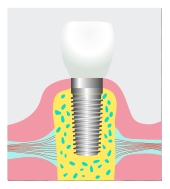
A dental implant is a synthetic metallic root substitute that is placed or implanted in the jaw bone. It can be used to replace a single missing tooth, provide an abutment (anchor or retainer), replace several missing teeth, or provide added retention to a removable dental appliance such as a full denture. In fact, if you are missing all of your natural teeth, it is possible to have maxillary (upper) and mandibular (lower) fixed replacements. The replacements do not come out and you cannot remove them yourself.

Two separate events are needed when replacing a missing tooth with an implant. First is the surgical phase in which the implant is placed. In the second phase, the replacement teeth are constructed and fixed into proper position.

The implant placement procedure involves making a small incision in the gum area where the implant is to be placed, preparing a site in the underlying bone, inserting the implant into the prepared site, and closing the tissue over the implant with several sutures. This area is left undisturbed, usually for 4 to 6 months. More healing time may vary due to the density of your bone. The lower jaw is composed of bone that is more dense than that of the upper jaw. This healing time allows for the slow integration of the implant within your jaw. The implant is held in place by the bone.
http://paulkorb.com/wp-content/uploads/dental_implant_01.jpg 
After the healing and integration of the implant, the placement site is exposed by reopening the gum. A post will then be fastened to the implant by cement or with internal threads. The crown, bridge, or other type of replacement will be attached to this post. Some dentists prefer to do all phases of the implant procedure themselves, but many choose to perform either the surgical or prosthetic (the actual construction of the replacement device) only. If this is the case, a periodontist or oral surgeon will perform the surgical portion of the implant placement.

Implants are very successful. Maxillary and mandibular implants are more than 90% successful. Lower implants have a somewhat higher success rate than upper implants. Occasionally, implants fail, but it is not common. Chances of an implant failure, many times, can be determined during or after the surgical phase before the replacement tooth or teeth are constructed.

Smokers take note: There is a heightened risk of dental implant failure among smokers - as much as a 20% greater failure rate!

We will discuss with you the requirements and options for your particular situation. There are usually several possibilities for effectively replacing missing teeth. It is important to decide on the design of the implant-retained replacement prior to the actual implant surgical procedure. Position and alignment of the replacement teeth need to be carefully considered before determining the location of the implant.

If you have any questions about implants, please feel free to ask us.