Showing posts with label omni. Show all posts

Wednesday, February 17, 2016

8 Tips for a Brighter Smile

Want a brighter smile? Try these tips!


1. Avoid foods that stain
Avoid foods and beverages that are filled with sugar or are too acidic. If you're not careful, consuming these kinds of foods can damage and stain your teeth. It can be helpful to drink beverages that stain through a straw as well. This helps you circumvent those smile dulling liquids altogether! Brushing your teeth immediately after eating sugary foods may also help prevent staining. Be careful though, if a food is too acidic, you will want to wait at least thirty minutes before brushing your teeth in order to prevent enamel erosion. If you cannot brush your teeth for some reason, opt for swishing water in your mouth which is naturally filled with fluoride. (Water is not a substitution for your daily dental routine).


2. Use dental cleaners
Between brushing, use dental cleaners to minimize the food build-up between your teeth. These brushes are disposable and very handy if you find yourself away from home without a toothbrush. You can also use them to clean the areas between teeth and brace wires if you have braces. They're sold at most grocery stores and can even be found online


3. Try toothpaste for sensitive teeth
If your teeth are especially sensitive, try using a toothpaste created specifically for people with sensitive teeth. If you're wondering whether or not you have sensitive teeth, here's a simple way to tell: Do your teeth feel uncomfortable when they are exposed to extreme hot and cold temperatures? If so, be sure to ask your dentist for help and additional information. 

4. Regular dental checkups
This one might seem obvious, but it is so important! Be sure to visit your dentist regularly to have your teeth inspected and cleaned. Without regular dental checkups, you run the risk of facing disease and other problems in the future. Routine dental visits help prevent the advancement of such diseases and are always a good idea


5. Avoid chewing on hard foods
Ice cubes pose a particular threat to the safety of teeth. Never chew on ice. You could crack or chip your teeth! Be cautious when eating popcorn, nuts or any other tough to chew food. If you believe that your teeth are chipped or cracked, see a dentist immediately to prevent pain or even bacteria growth in the cracked tooth. 


6. Brush your teeth properly
Brush your teeth from the gum line moving towards the center of your mouth. This will help get rid of food bits that hide under your gums. Scrubbing side to side is always good, but don't forget to brush with an up and down motion as well. If your gums or mouth bleed while brushing, be sure to meet with a dentist or periodontist. Bleeding gums are often a sign of gum disease, which is a major issue when left untreated. 


7. Swirl that Mouthwash
One common misunderstanding regarding oral health is that brushing is all you need for a healthy mouth. Mouthwash is often neglected in daily dental practice, but it's an essential step towards your brighter smile. Mouth wash cleans, disinfects, and reaches places your toothbrush simply cannot. Rinse twice per day when you brush those pearly whites.


8. Drink your Milk! 
In addition to providing a good source of calcium, dairy has shown to help your teeth fight cavities. If you're lactose intolerant or simply dislike dairy products, don't worry! Dark leafy greens like kale or collards, broccoli, tofu, and even almonds are all excellent natural sources of calcium.


If you have any questions regarding the health of your teeth or simply want to see a doctor, call one of our three convenient locations to set up an appointment. We are here to provide excellent service in a friendly environment.  

North location on Hymeadow Drive: (512) 250-5012
Central location on Jollyville Road: (512) 346-8424
South location on William Cannon Drive: (512) 445-5811

Wednesday, February 10, 2016

X-Rays and the Dentist


If you've been to the dentist recently, then you have most likely had an X-ray done. While they aren't taken during every visit, they are very helpful for establishing a patient's oral health as well as predicting which areas need to be focused on. Today we are going to give a brief overview of what exactly they are and why they are necessary. 


1.  What are X-rays? 
In 1895, Wilhelm Conrad Roentgen was working in his lab conducting research when he accidentally discovered X-rays. Since then, science and technology have evolved to use X-rays in a beneficial manner. During an exam, a patient is exposed to short bursts of radiation. This allows the doctor to view teeth in a more thorough manner than an examination. Some people are nervous about getting X-rays, however, it is important to note that the doses of radiation are too minute to cause adverse effects. In fact, during a dental X-ray, patients are only exposed to the same amount of radiation as a short airplane flight

2. Do I have to get X-rays?
Whether you need to look for fractures in bone or simply to check in on teeth, X-rays are the best way to do it. Dentists rely on this technology because it allows them to perceive problems before the naked eye is able see them. Some examples include, but are not limited to: periodontal disease, bone infections, hard to see tooth decay, and even some tumors. X-rays are an important part of preventative care and are nothing to be afraid of.

3. What if I'm pregnant?
This is always a great question to ask! It is best to consult your physician before exposing yourself to small quantities of radiation. Informing your dentist of this is an absolute necessity, but there is no need to forgo X-rays altogether. With pregnant patients, a thyroid collar and a leaded apron are used to prevent radiation exposure.

Source: Mouth Healthy by the American Dental Association

If you have questions concerning X-rays and the health of your teeth, feel free to call one of our three offices to schedule a consult. We are here to address any of your concerns and to provide you with a stress-free dental experience.

North location on Hymeadow Drive: (512) 250-5012  
Central location on Jollyville Road: (512) 346-8424  
South location on William Cannon Drive: (512) 445-5811

Wednesday, October 1, 2014

Replacing Unesthetic Restorations

There are 2 types of life spans:
Everything has a life expectancy, even dental filling materials. Dental materials appear to have two different types of life spans - a functional life span and an esthetic life span. The better the original dental restorative material and the skills of the operator, the longer the restoration will last. Lab-processed materials will generally last longer than direct placement materials.

What is the functional life span?
The functional life span is defined as the length of time a material will last before it fails to function properly. This failure will either (a) weaken the tooth or (b) permit decay or gum disease to begin. For example, when a piece of the filling breaks off (or often in the case of an amalgam [silver metal] filling, it causes a piece of the tooth to break off), the tooth requires a new restoration.

How is the esthetic life span different from the functional life span?

An esthetic life span is somewhat different. In the case of bonded and tooth-colored restorations, it means that the material, while possibly still able to function, has begun to degrade. A filling may have matched the tooth beautifully when placed, but over time, the change in color of the filling material, as well as actually tooth color changes, cause an obvious mismatch between tooth and filling material. Since the restorative material does not have the same properties as tooth enamel, it will wear a little differently. The shape will change over time, too. Luckily, it is a very slow process.

With lab-processed restorations, crowns and bridges, the crown may still be working well, but age and changes in your mouth make it and the surrounding soft tissues look less acceptable that it was when first placed. Again, this happens slowly, over many years.

What other esthetic problems can be fixed? 
Other esthetic problems that can be corrected include notches in fillings or under crowns caused by improper brushing (or decay), recession of the gum tissue that exposes  darker root surfaces around crowns or fillings, porcelain crowns (caps) that no longer match the adjacent teeth, and metal margins of crowns that are visible due to gum recession (and this is quite common).

Why should you consider getting new dental restorations?
When you can see these types of changes, you can be sure that others who look at you when you are speaking or smiling will see them too. If you place a high value on your personal appearance, this is the time to consider having the restorations replaced with newer materials. Newer dental restorative materials look better, last longer, are more color-stable, and more wear-resistant than older-generation bonded materials. You can expect them to look good for many years.

What fillings look the best?
In our opinion, silver metal fillings never look "good." Even at this best, polished and shined, they do not represent a picture of health. As the metal ages, it corrodes, pits, and darkens. Its constant expansion and contraction due to hot and cold foods we eat weakens the tooth. The darkening of a filling can cause a darkening of the tooth itself. After time, the tooth will become permanently dark gray. The wider your smile is (and the more teeth you show when talking and smiling), the more of a problem this can be. The most esthetic filling are tooth-colored.

What happens if I choose to keep my old fillings?
Broken, stained, worn, and visible fillings detract from your appearance. When you look at a tooth (from about 2 feet away) that has been restored, you should not see the filling. While these types of problems are, of course, non life-threatening, consider attending to them before they get worse - and difficult and expensive to correct.

In our office, we place a high value on the appearance of your teeth and how you feel about your smile. We want you to look your best. We use the best materials and techniques available in dentistry today to ensure a healthy smile. We will be happy to evaluate your particular condition and discuss options with you.

If you have any questions about replacing unesthetic restorations, please feel free to call our office to discuss restoration options at 512-250-5012.

Wednesday, July 9, 2014

Foods That Cause Tooth Decay

Cariogenic: causing tooth decay.
Foods (such as candy and sweets) that contain sugar and other carbohydrates that can be metabolized by bacteria in plaque are described as cariogenic

How long food remains in mouth:
  • Sugary liquids, such as soft drinks, leave the mouth quickly and are not as cariogenic
  • Sticky foods, such as raisins or caramels, adhere to the teeth and stay in the mouth longer and are more cariogenic
Frequency vs. Amount:
  • Someone who snacks all day on small amounts of cariogenic food is far more likely to develop decay
  • Someone who eats a larger amount of cariogenic food, but only once a day, is less likely to develop decay 
Refined carbohydrates vs. Complex carbohydrates:
  • Foods such as crackers, although not sweet, are cariogenic because they contain refined carbohydrates that stick to the teeth. They remain in the mouth long enough to be broken down into sugars that can be used by the bacteria in plaque.
  • Complex carbohydrates, such as fruits and vegetables, are less cariogenic because they clear the mouth before they are converted into simple sugars that can be used by bacteria.  
Flow of saliva to speed clearance of food from mouth and provide a source of dietary fluoride to strengthen the tooth and assist in remineralization
  • Sugarless gum or hard candy, as well as sipping water frequently, will increase the saliva flow
  • Various medicines can cause a dry mouth, and try to avoid spicy or salty foods

Thursday, July 3, 2014

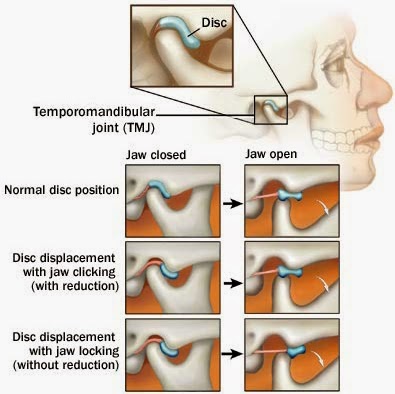
Does your jaw click when you open your mouth?

If you experience a clicking jaw when you open your mouth, or if your jaw locks, you may be experiencing problems with you temporomandibular joint. Problems with your jaw joint, known as the temporomandibular joint (TMJ) are considered a part of temporomandibular disorder (TMD).

No pain
If you do not experience any pain with it, you do not need an invasive procedure to correct it. You can try wearing a well-made night guard at night.

Pain
If you do experience pain associated with your clicking jaw, then the joint may be inflamed. Try to avoid over-working your jaw: eat easy-to-chew foods, do not open your mouth wide. Keep in mind that other conditions cause similar symptoms to TMD, such as a toothache, sinus problems, arthritis, or gum disease. See your dentist for a diagnosis and to receive treatment for this problem.

A previous blog post outlines the symptoms often associated with TMD 

Discomfort
Jaw surgery is usually not necessary. Occasional discomfort in the jaw joint and chewing muscles is quite common and usually not a cause for concern. If you are diagnosed with TMD, you can use simple self-care practices to relieve discomfort:
  • eat soft foods
  • do not open your mouth wide
  • do not chew gum
  • apply heat or ice packs
  • avoid extreme jaw movemetns
  • nonsteroidal anti-inflammatory drugs
  • muscle relaxants
  • physical therapy 
  • wear a night guard at night

If you have any questions about TMJ or your jaw joint, please feel free to ask us.


Wednesday, July 2, 2014

Classification of Periodontal Disease

Any periodontal disease is undesirable and, if left untreated or ignored, can lead to a number of serious dental problems. If you wish to maintain your teeth and gums (gingiva) in a healthy and disease-free state, it is important that you brush properly and use dental floss daily. Do these procedures as we have instructed. Return for continuing dental hygiene care at the time intervals that we have recommended. These time intervals for your cleaning appointments have been established specifically for your existing dental condition. The intervals can and will fluctuate according to your ability to take care of your teeth and gums. A periodontal infection is site-specific and episodic in its nature. Any delay in your office-related routine dental hygiene recare appointments could prove detrimental to your oral health. 

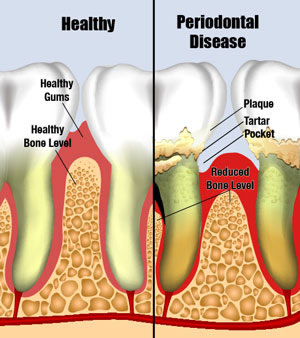
What is periodontal disease? Periodontal disease is an infectious process classified according to how much damage has been done to the structures surrounding the teeth, namely the gingiva (gums) and bone. It is an infection in your mouth. The better you clean your teeth to remove all the plaque bacteria, the less likely you will be to develop periodontal disease. A previous blog post details how the disease progresses and how to solve it.

The following is a brief overview of the American Academy of Periodontology's classification of the types of periodontal disease.

Type 1 - Gingival Disease: An inflammation or lesion of the gum characterized by changes of color, gingival form, position, surface appearance, and presence of bleeding and/or pus.


Type 2 - Chronic Periodontitis: An inflammation of the supporting structures of the teeth associated with plaque and calculus; the rate of progression is affected by local, systemic, or environmental factors. It can be further classified as localized or generalized.


Type 3 - Aggressive Periodontitis: Characterized by a rapid rate of periodontal disease progression in an otherwise healthy individual in the absence of large accumulations of plaque and/or calculus. It can be further classified as localized or generalized.


Type 4 - Periodontitis as a Manifestation of Systemic Disease: Periodontitis associated with blood or genetic disorders.


Type 5 - Necrotizing Periodontal Disease: Ulcerated and necrotic gums between the teeth and at the tooth margins. It can be further classified as necrotizing ulcerative gingivitis or necrotizing ulcerative periodontitis.


Type 6 - Abscesses of the Periodontium: A localized pus-forming infection of the periodontal tissue.


Type 7 - Periodontitis Associated with Endodontic Lesions: Localized deep periodontal pocket extending to the tip of the root of the tooth involving pulp death.

Type 8 - Developmental or Acquired Deformities and Conditions: Gingival disease or periodontitis started by localized tooth-related factors that modify or predispose to plaque accumulation or prevention of effective oral hygiene measures.

Due to the nature of the disease, most classifications will involve both a generalized and a localized diagnosis. 

See this previous blog post for early detection signs of periodontal disease.

If you have any questions about the classification of your periodontal disease, please feel free to ask us.

Tuesday, July 1, 2014

Maryland Bridge (Bonded Resin Retainer)

The Maryland bridge, or bonded resin retainer, is an alternative to implants and conventional crowns to replace missing teeth. This type of replacement procedure can be considered when the space to be restored is next to teeth in good alignment that are not heavily restored with filling materials. Because this type of bridge is adhesively bonded to the enamel on the abutment teeth, having adequate enamel is important. A Maryland bridge is fixed into place and is not meant to be removed at night.

Maryland Bridge vs. Fixed Bridge
One advantage of this process over a conventional bridge is that a missing tooth can usually be replaced with a minimum amount of preparation (drilling) of the remaining teeth. It is not necessary to prepare the tooth to the same extreme degree as with full tooth coverage restorations (crowns or caps). This method is an extremely conservative procedure. It is also less expensive (about one quarter less) than a conventional bridge. Tissue health around the abutment teeth is usually excellent because little or no preparation of the tooth structure near the gingival (gum) tissues is needed. Unlike conventional full coverage restorations, teeth prepared for a Maryland bridge retainer will not need endodontic treatment (root canal therapy) at a later date.

If the patient has abusive eating or bruxing (grinding) habits, this type of restoration is contraindicated. Although we do consider it more of a restoration for posterior (back) teeth rather than anterior teeth, it does display metal more so than a conventional bridge. The biggest disadvantage of a Maryland bridge is that the expected life may not be as long as that of a conventional bridge made of full coverage crowns. This technique was only introduced in the early 1980s and therefore does not have the extensive successful history of full coverage bridges. While breaking of a Maryland bridge is not likely, debonding can occur, requiring a re-cementation. In some rare instances, it might have to be redone. In either case, you may be charged a fee for the procedure. A Maryland bridge is a fixed replacement for a missing tooth, but one that will need to be redone in the future. The success rate at 5 years of Maryland bridges in our practice is approximately 80%. However, this is a much better result than the national average, which shows a success rate of about 33% at 4 years. Maryland bridges are most appropriate for single-tooth replacement. 

If dental implants are not an option for you for tooth replacement and you do not want the teeth on either side of the space to be radically prepared (cut down or drilled), then you should consider the Maryland bridge technique. For many patients, the advantages of less drilling of the teeth and the reduced cost make it a desirable alternative.

If you have any questions about the Maryland bridge technique, please feel free to ask us.

Monday, June 30, 2014

What Are Implants?

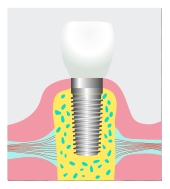
Have you lost your teeth due to: severe tooth decay, gum disease, trauma, or even a failed root canal? You may qualify for implant treatment. Dental implants are used to replace one or more missing teeth in your mouth. Implants are made of titanium or similar materials that are well suited to the human body. Implants are artificial replacements for teeth roots that support a restoration or a dental appliance. 


Twenty-five years ago, if someone described how missing teeth could be replaced with implants, it might have been called a miracle. Ten years ago, the use of dental implants to replace missing teeth might have been called astounding. Today, implant procedures are called routine. We would like you to have a basic understanding of what implants are, what can be expected from them, and what limitations they might have in your specific area of need.

dental implant Austin
A dental implant is a synthetic metallic root substitute that is placed or implanted in the jaw bone. It can be used to replace a single missing tooth, provide an abutment (anchor or retainer), replace several missing teeth, or provide added retention to a removable dental appliance such as a full denture. In fact, if you are missing all of your natural teeth, it is possible to have maxillary (upper) and mandibular (lower) fixed replacements. The replacements do not come out and you cannot remove them yourself.

Two separate events are needed when replacing a missing tooth with an implant. First is the surgical phase in which the implant is placed. In the second phase, the replacement teeth are constructed and fixed into proper position.

The implant placement procedure involves making a small incision in the gum area where the implant is to be placed, preparing a site in the underlying bone, inserting the implant into the prepared site, and closing the tissue over the implant with several sutures. This area is left undisturbed, usually for 4 to 6 months. More healing time may vary due to the density of your bone. The lower jaw is composed of bone that is more dense than that of the upper jaw. This healing time allows for the slow integration of the implant within your jaw. The implant is held in place by the bone.
http://paulkorb.com/wp-content/uploads/dental_implant_01.jpg 
After the healing and integration of the implant, the placement site is exposed by reopening the gum. A post will then be fastened to the implant by cement or with internal threads. The crown, bridge, or other type of replacement will be attached to this post. Some dentists prefer to do all phases of the implant procedure themselves, but many choose to perform either the surgical or prosthetic (the actual construction of the replacement device) only. If this is the case, a periodontist or oral surgeon will perform the surgical portion of the implant placement.

Implants are very successful. Maxillary and mandibular implants are more than 90% successful. Lower implants have a somewhat higher success rate than upper implants. Occasionally, implants fail, but it is not common. Chances of an implant failure, many times, can be determined during or after the surgical phase before the replacement tooth or teeth are constructed.

Smokers take note: There is a heightened risk of dental implant failure among smokers - as much as a 20% greater failure rate!

We will discuss with you the requirements and options for your particular situation. There are usually several possibilities for effectively replacing missing teeth. It is important to decide on the design of the implant-retained replacement prior to the actual implant surgical procedure. Position and alignment of the replacement teeth need to be carefully considered before determining the location of the implant.

If you have any questions about implants, please feel free to ask us. 

Tuesday, June 17, 2014

Partial Dentures


A partial denture is designed to replace one or several missing teeth. You may consider a removable partial denture to replace the missing teeth, if:
· you have missing teeth
· the remaining teeth cannot accept a fixed bridge
· there is not sufficient bone for implants
· finances are limited

Removable partial dentures have been made by dentists and worn by patients for many years.  Partial dentures are composed of three different materials. A cast metal base with clasping arms holds a pink plastic gum tissue and plastic or porcelain teeth. The metal clasps are silver in color and, depending on the individual circumstances, may or may not be visible when you talk or smile. These clasps are absolutely necessary to hold the partial in place. Their location and design are dictated by the shape and position of your remaining teeth and which missing teeth will be replaced. We will show you where the clasps are to be located in your mouth. Most of the time, the amount of preparation (drilling) of your natural teeth needed to ensure successful clasp design is minimal. Often there is no need for a local anesthetic injection. This is unlike fixed bridgework, which always requires significant tooth reduction for proper design and fit.

If you find that the appearance of the clasps will be objectionable, then you might consider different possibilities. It is common to place crowns on the teeth that are clasped by the metal arms, and then place the clasps inside the crowns. This will give you a more natural appearance, but it will add to the ultimate cost of treatment. It involves significant preparation of the natural tooth and you might also want to rethink about fixed bridges or implants.

The base of the partial denture will rest lightly on your gum tissue. At some time in the future it is expected that you will need adjustments to the base. Usually this means an addition of more pink material to the denture base. Clasp arms will loosen and need to be tightened at various times. Weight loss or gain will also affect the fit of the base of the partial.

Although a partial is less expensive than a fixed bridge, which is metal and porcelain cemented into place, there are several possible drawbacks. It is much more bulky than a bridge and is more difficult to wear initially. You may have to adjust the way you speak to accommodate the extra bulk. After awhile, this will not be much of a problem. And depending on the position of the retaining clasps, they may be visible when you talk or smile.

Do not sleep with the partial dentures in place.  The partial dentures absolutely must be removed during sleep time to be cleaned and give the clasped teeth a chance to rest. The gum tissue under the denture needs a chance to breathe and reestablish proper blood circulation. The partial denture can compress the tissue and reduce blood flow in the area. Plaque can accumulate on your denture and your gum tissue.  Use a very soft toothbrush to gently brush your gums.  Also brush your partial denture daily with a denture brush and denture cleanser.  Always store your partial denture in water when you are not wearing it.