Showing posts with label prevention. Show all posts

Friday, January 27, 2017

Sealants and Fluoride: Benefit to Adult Patients

Dental decay can develop at any time, regardless of a person’s age. A change in diet, change in lifestyle, change in oral self-care habits, the use of prescription medications, or a change in systemic health due to the normal aging process can all affect the caries (decay) susceptibility. Few people remain completely free of decay. Proper oral self-care on your part and properly spaced dental hygiene prevention appointments will go a long way to reduce the opportunity to have new decay begin.
As you age, it is possible that some of your gum tissue will recede, exposing the root surfaces of your teeth. This gum recession can occur from improper brushing (brushing too hard with a hard toothbrush) or as a result of past periodontal problems. The more a tooth and root are exposed, the greater is the surface area you will have to keep clean. Sometimes the teeth with exposed roots are very hard to keep clean. These roots may be sensitive to temperature changes and are often times uncomfortable to brush. Decreased salivary flow helps to create a breeding ground for bacteria to accumulate on the enamel and especially on the root surface. And root decay usually progresses quite quickly!

Goal of Prevention
Your goal should be to keep the dentist from drilling your teeth. Any reasonable preventative measure that is available should be seriously considered. When the dentist drills, you lose. When the dentist does not drill, you win,

Dental Sealants
Although sealants are primarily designed for children, adults who have a history of active decay should consider having sealants placed on the posterior (back) teeth where indicated. We will tell you where it is possible to place the sealants. Even if you have not had a cavity for a long time, consider the application of a sealant as an inexpensive insurance policy for your teeth. Perhaps you would never get decay on the unsealed surfaces. But, just as you insure your home against destruction by fire, a sealant insures the tooth surface from decay. Preventative measures may allow you to avoid having your teeth drilled. You win!  

Topical Fluoride
For a similar reason, we advise the use of topical fluoride treatments for adults. The effectiveness of systemic and topical fluoride in preventing decay is well documented. When a cavity first starts, an application of fluoride might (depending on when it is used) reduce or eliminate the need for drilling.
An alternative to the fluoride treatment we can provide in our office is a daily rinse. If you can rinse with an over-the-counter mouthrinse containing fluoride every night as directed on the rinse label, you do not need the office topical fluoride treatment. If you cannot rinse daily as instructed, you will need the benefit from a stronger office-applied topical fluoride treatment. Your oral health will benefit most from small increments of fluoride that are applied daily rather than one large concentration every 6 months. However, only you know whether you will be faithful to your rinsing routine. When in doubt, let us do it here.

If you have been a patient of Omni Dental Group, you know that we stress prevention of dental disease above all else. Sealants and topical fluoride treatments are two of the more preventative dental measures that we believe will significantly enhance your oral health. 

Tuesday, July 15, 2014

Prevention of Decay

What is dental decay, and how do dentists fix it?
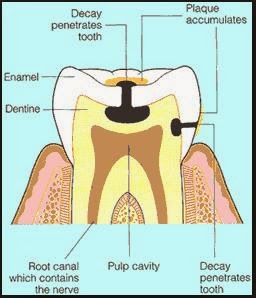
Dental caries (decay) is a bacterial infection, first of the enamel, then of the dentin of the tooth. The tradition in dentistry has been to surgically remove the diseased portion of the tooth by "drilling" out the decay and then filling the resulting hole in the tooth with some inert material. As most adults know, this procedure will be performed over and over again when new decay begins or when the filling (often silver) breaks or the tooth fractures.

Click here to learn about decay in young children.

Why should I practice prevention?
Would it not be better to eliminate the cause of the infection and thus not be forced to have big holes drilled in the teeth? We believe the bacterial cause of the infection should be addressed.

How do I prevent dental decay?
There are several positive steps that you can take to reduce your risk of dental decay. 

A. At the dentist's office
1. First, all the active decay in your mouth should be treated immediately. 

2. Next, all teeth that would benefit from sealants should be treated. 
  • Why? This will prevent bacteria from reaching into the pits, fissures, and grooves that normally exist on the occlusal (biting) surfaces of teeth. Any stray bacteria that may still be in the sealed area are effectively cut off from their source of food and become inactive. Although sealants are most effective on teeth that have not been previously restored, they can be successfully placed on teeth filled with bonded fillings.
3. The infection can be treated with antimicrobials. 

4. We believe that the use of a fluoridated mouthrinse twice daily or use of a prescription fluoridated dentifrice as directed provides a great advantage. 
5. We may also prescribe a chlorhexidine mouthrinse, an antimicrobial oral rinse that has a great effect on Streptococcus mutans.

B. In your daily life
6. Your diet and oral self-care are important in dental decay prevention. When you eat junk food and drink sugary liquids, your teeth are more prone to decay. The more frequently you snack, the more prone your teeth will be to decay. 

7. If your brushing and flossing are not effective, your teeth will be more prone to decay. When you can't brush after a meal, at least rinse your mouth with water within 15 minutes to dilute the acids forming from the ingested food or drink. 

8. If you have a diminished salivary flow, take frequent sips of water during the day to help dilute the acids produced by the bacteria.

What if decay keeps coming back?
If you have a continuing problem with active decay, we recommend more frequent preventive recare appointments. It has been repeatedly shown that patients who have good oral self-care and maintain a recare interval of 3 to 4 months have many fewer dentally related (cavities or gum disease) problems.

Present-day dental suggestions are based on proven scientific information. You might need to have your teeth cleaned by the hygienist twice each year, or you may need to be seen more frequently. 

For certain individuals, we also suggest testing the oral bacterial levels to determine the magnitude and presence of a Streptococcus mutans infection and to determine your risk level for future dental disease.

If you have any questions about the prevention of dental decay, please feel free to ask us.

Wednesday, July 9, 2014

Foods That Cause Tooth Decay

Cariogenic: causing tooth decay.
Foods (such as candy and sweets) that contain sugar and other carbohydrates that can be metabolized by bacteria in plaque are described as cariogenic. 

How long food remains in mouth:
  • Sugary liquids, such as soft drinks, leave the mouth quickly and are not as cariogenic
  • Sticky foods, such as raisins or caramels, adhere to the teeth and stay in the mouth longer and are more cariogenic
Frequency vs. Amount:
  • Someone who snacks all day on small amounts of cariogenic food is far more likely to develop decay
  • Someone who eats a larger amount of cariogenic food, but only once a day, is less likely to develop decay 
Refined carbohydrates vs. Complex carbohydrates:
  • Foods such as crackers, although not sweet, are cariogenic because they contain refined carbohydrates that stick to the teeth. They remain in the mouth long enough to be broken down into sugars that can be used by the bacteria in plaque.
  • Complex carbohydrates, such as fruits and vegetables, are less cariogenic because they clear the mouth before they are converted into simple sugars that can be used by bacteria.  
Flow of saliva to speed clearance of food from mouth and provide a source of dietary fluoride to strengthen the tooth and assist in remineralization
  • Sugarless gum or hard candy, as well as sipping water frequently, will increase the saliva flow
  • Various medicines can cause a dry mouth, and try to avoid spicy or salty foods

Friday, June 13, 2014

Early Childhood Caries


What is early childhood caries?                     

Early childhood caries, which used to be called “baby bottle tooth decay” and “nursing caries,” is a severe form of dental decay found in very young children who presumably are put to sleep with any liquid other than water in a bottle. Children who have experienced prolonged breastfeeding will have the same type of tooth decay patterns. Many times, the decay is very advanced before the parent notices the problem. This is another reason that we want to see your child for his or her first dental visit while those new teeth are still in the eruption phase.

How does early childhood caries develop?

The teeth most affected by early childhood caries are the upper front teeth. As the child falls asleep with a bottle containing any liquid other than water (or at the breast), pools of the sugared liquid collect against the tooth surfaces. These sugars feed the bacteria found in bacterial plaque to produce an acid, which starts the decay process. When the demineralization process is not stopped through proper prevention, the crowns of the teeth can be destroyed to the gum line; abscesses can develop, and the child can experience severe pain and discomfort.

What is the best prevention?

When oral bacteria are fed liquid sugar for a prolonged period of time, the resulting acid can be very damaging to tooth structure. Similarly, when oral bacteria are fed little bits of sugared liquid, nonstop, over a day’s time, the results can be quite damaging to tooth structure.

We believe the best prevention for this type of problem begins with an understanding of the decay process, and how you can stop it before it even starts. We recommend that you bring your children to the dentist when they are in the infant stage so that we can perform an infant oral examination and discuss with the child’s oral self-care, including:

·         Children should not be put to sleep with a sugared liquid in a bottle. No milk. No juice. No soda. Plain water only.
·         Children, including infants, require daily oral cleansing. If no teeth are present, the gums should be gently wiped with a wet cloth.
·         When teeth are present they should be brushed with fluoridated toothpaste, but only with a very small amount about the size of a pea, or less.
·         Liquid sugars and other easily fermentable carbohydrates such as white bread, cakes, cookies, or crackers should be given with meals and not as “snacks.”
·         The proper level of systemic fluoride should be in place by the time your child is 6 months of age.