Showing posts with label flossing. Show all posts

Wednesday, February 15, 2017

Xerostomia: Dry Mouth Syndrome


Xerostomia (dry mouth) is not a condition everyone should expect. You may notice it as you age due to a change in hormones, medication, and/or radiation therapy in the head and neck region.

Why Xerostomia Is a Problem
Saliva is important to oral health for several reasons. The flow of saliva helps clear debris from the oral cavity. It provides minerals necessary to support the process of remineralization. Tooth enamel daily undergoes acid attack that removes inorganic minerals from teeth. This is called demineralization. Remineralization is the opposite of demineralization. It occurs when inorganic molecules flow into a region of weakened enamel and make it stronger.

When the salivary flow is reduced, a chain of events occurs. The natural cleansing action is diminished, as are the buffering action and remineralization properties of saliva. People with diminished salivary flow experience a very fast rate of decay, many times faster and over several teeth. This type of dental decay is typically noted along the gumline, around existing dental work, and on exposed root surfaces.

Prevention
You can help prevent dental decay that can result from xerostomia:
  • Brushing and flossing correctly twice a day becomes very important.
  • Frequent sips of water during the day can help moisten the mouth and can help clear debris.
  • Daily use of a mouthrinse containing fluoride can help remineralize teeth.
  • Use a toothpaste containing sodium fluoride.
  • We recommend a daily brushing with a prescription, high-concentration sodium fluoride gel or paste. We will either dispense this or give you a prescription for it.
  • Chew sugarless gum or a rubber band to stimulate salivary flow.
  •  In moderate to severe cases, special fluoride delivery trays can be made for you to use at home. These will keep the high-concentration fluoride in a position to “soak” your teeth with fluoride for several minutes at a time.
  • We recommend that you have your teeth cleaned, polished, and an office-applied topical fluoride treatment every 3 months while the condition persists.

Dry mouth can have serious dental consequences and must be treated accordingly.
If you have any questions about xerostomia, please feel free to contact us at any of our three office locations:
Hymeadow: (512) 250-5012
Jollyville: (512) 346-8424
West William Cannon: (512) 445-5721

Tuesday, August 12, 2014

Scaling and Root Planing

What is scaling?
Scaling is a periodontal dental procedure in which plaque and calculus are removed from the tooth both above (supragingival) and below (subgingival) the gum (gingiva). 

What is root planing?
Root planing is a procedure in which diseased or altered portions of the root surface, the cementum, and dentin are removed and the resulting new surface is made smooth and clean. The more altered and damaged the root surface has been from calculus (tartar) accumulation, the more the need for root planing.

Why is it necessary?
The purpose of scaling and root planing is to remove all debris from the teeth. Any item that can cause inflammation of the gum tissue must be eliminated. The root surface must be made as smooth as possible. Irregularities in the root surface can contribute to gum inflammation. Irregularities are sites for bacteria and plaque buildup. The bacteria and the toxins they produce in the plaque are held against the tooth by the calculus. In this way, plaque and calculus on the teeth have been positively linked to gum disease.

What is the procedure like?
Depending on the severity of your particular periodontal problem, scaling and root planing may be the definitive treatment and no further procedures will be required. In many cases scaling and root planing are only a necessary part of the overall therapy. It is a demanding procedure. It requires much more time than the familiar adult prophylaxis (cleaning). It is usually done in multiple appointments, treating a quarter, half mouth, or your full mouth at each appointment. In this office we find that most patients are most comfortable if the area to be treated during the root planing procedure is anesthetized with a local anesthetic.

Recare
The scaling and root planing may have to be repeated in the future. It is customary to place the patient on a 3- to 4-month hygiene recare schedule. Scientific evidence clearly shows that for individuals who have demonstrated a predisposition to periodontal disease, an interval of 6 months is too long. We will determine the appropriate interval for you. As your situation changes, there may be changes in the length of these intervals as well.

What happens after treatment?
Other than the teeth being somewhat sensitive after the scaling and root planing procedure, there is little postoperative discomfort. The sensitivity will diminish with time. If you have been diagnosed as having severe periodontal infection, the sensitivity may remain for quite some time and further procedures may be needed to eliminate sensitivity. Although many procedures in dentistry can be considered elective, we consider scaling and root planing to be a necessity for your dental health.

Post-procedure Tips:
  • If therapeutic prophylaxis has been completed because your gingival (gum) tissue showed signs of infection and inflammation, and if you had significant calculus (tartar) buildup:
    • You may notice that your teeth feel different where the calculus was removed. The soft tissues may be sensitive or sore for approximately one day as they begin to heal. You may find that taking an over-the-counter pain reliever (aspirin, ibuprofen, etc.) will help during this 24-hour period. You may also rinse your mouth every few hours with warm salt water. Make sure that you brush and floss your teeth during this time period as you have been instructed. be gentle, because the brushed areas may be sore, but be thorough! You do not want to have the periodontal infection begin again.
  • If scaling and root planing, or other more involved periodontal procedures has been completed:
    • You can expected your gingival (gum) tissues to be quite sore. This is normal when the gum tissues have been infected and inflamed for some time. The more severely they have been affected, the more discomfort you can expect. This soreness should go away very quickly. You may rinse with warm salt water every few hours until the soreness is gone.
  • If scaling and root planing has been completed:
    • You may also notice that the teeth have become sensitive to temperature changes after the scaling and root planing. This sensation frequently occurs when the surfaces of the roots of your teeth have been cleaned. Removal of the debris covering the roots and attached to the roots leaves the roots open to temperature stimulus. If the problem persists, please let us know.
  • When you examine your gums closely in a mirror, you will also observe that the color, texture, and position of your periodontal tissues will undergo a change as the healing takes place. The swollen, reddened gum tissue will shrink, become more firm, and return to a healthy pink color. Watch for these welcome signs of improvement and be encouraged by the healing process.
  • Please do not forget to brush, floss, and use other periodontal cleaning aids as you have been taught. It is important that you begin establishing proper oral self-care habits immediately. If you find that the recently treated areas are sensitive to the brushing and flossing, be gentle - but be thorough! With proper technique you cannot damage the teeth or gingival tissues.
  • Brush after ever meal with a fluoride-containing toothpaste. Rinse with a fluoride-containing mouthrinse once each day.
Preventing Recurrence
Once scaling and root planing has been completed, it is most important for you to practice the brushing and flossing techniques in which you will be instructed. If we have recommended any additional periodontal aids, you must use them, too. Your cooperation is vital if the procedures are to be successful. To remain disease-free, you will need to remain constant in your oral self-care regimen.

If you have any questions about scaling and root planing, please feel free schedule a comprehensive dental exam with our office at 512-250-5012.

Thursday, July 17, 2014

A Beginner's Basics to Braces

How can orthodontics help you?
If your teeth are in poor alignment, you could be facing a functional or cosmetic problem. Orthodontics (braces) can eliminate that problem for you. One of the first things people notice about you is your smile and how your teeth look. You don't have to be a dentist to notice poorly positioned, crooked teeth. In today's culture, crooked teeth are not regarded as attractive or desirable. Most people, when asked, say that they would like to have straight teeth. Straight, white teeth are the cosmetic dental improvements patients most request.

Braces may also be suggested to correct a specific dental problem that only affects one or several teeth. This is not a cosmetic tooth repositioning, but rather a functional tooth movement. Occasionally, in order to properly finish an orthodontic case, the orthodontist may ask the dentist to adjust the enamel of some teeth or bond a resin to some teeth to improve the occlusion (bite alignment) or to enhance cosmetics. This will be discussed with you as soon as it becomes apparent.

When should you see an orthodontist?
The need for orthodontics is best discovered when you are young. A dentist will have a good indication of whether or not your teeth will be straight when he sees you as a child 6 to 8 years of age. Most treatment would not begin until a patient is 8 years old, although in some cases, orthodontics can be started earlier.

It is easier to direct the movement of teeth in a child. Early tooth guidance is a very important phase of orthodontic care, which can take place even though all the permanent teeth are not yet in place. Certain problems are much easier to correct at this stage of a "mixed dentition" of baby and permanent teeth. An average case can last from 18 to 24 months.

While orthodontic therapy is admittedly easier in the child patient, you are never too old to begin orthodontics. The number of adults seeking orthodontic treatment has risen dramatically during the past decade. As long as you have healthy bone support for your teeth, you can have orthodontic therapy. Most adult cases take 18 to 24 months to complete.
What are retainers?
Once braces are removed, it is usually necessary to wear a retainer. After your braces come off, your orthodontist will make a mold of your mouth and produce a set of retainers. This retainer will maintain the new tooth alignment until the teeth have had a chance to become firmly set in their new positions. This retainer may be either removable or fixed in place. Aside from a permanent bonded retainer, there are two other types that most people get.

A Hawley Retainer is made of acrylic and metal. The acrylic goes behind your teeth and up against your upper palate; the metal is in front of your teeth. This is the most reliable refinements that still need to be done to your teeth.

Orthodontic Toothbrush
An Essix Retainer is clear plastic and looks like an Invisalign aligner tray. Many people want this type of retainer, but it has its disadvantages. Many orthodontists feel that because it covers the biting surface of your teeth, they do not "settle" properly after treatment. For this reason, sometimes orthodontists give a patient both types of retainers: an Essix Retainer to wear during the day when they are people-facing, and a Hawley Retainer to wear at night when they are home sleeping.

No matter what type of retainer you get, the most important thing is to wear it exactly as the orthodontist tells you. Most people need to wear their retainers 24/7 for at least 6 months, then switch to wearing it only at night when sleeping. 

How do I keep clean teeth with braces on?
While orthodontic treatment is in the active phase, that is, while the braces are on your teeth, you must be very diligent about keeping your teeth clean. This will be more difficult than and somewhat different from cleaning your teeth without braces. You will be instructed in the use of any cleaning aids needed. These may include dental floss threaders, orthodontic toothbrushes, an oral irrigator to flush out debris, proper brushing habits, fluoride mouth-rinses, and periodontal aids. You must follow your proper oral self-care routine each night to prevent decay, decalcification of the teeth, and gum disease. You also should not use a whitening toothpaste when you have braces. It could cause you to have "two tone" teeth after the brackets are removed. Another thing to remember is that although a device like a Waterpik is great for gum stimulation and dislodging food, it is not a substitute for flossing. You still need to floss daily.

Tuesday, July 15, 2014

Prevention of Decay

What is dental decay, and how do dentists fix it?
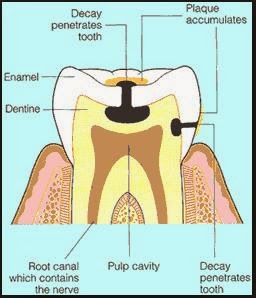
Dental caries (decay) is a bacterial infection, first of the enamel, then of the dentin of the tooth. The tradition in dentistry has been to surgically remove the diseased portion of the tooth by "drilling" out the decay and then filling the resulting hole in the tooth with some inert material. As most adults know, this procedure will be performed over and over again when new decay begins or when the filling (often silver) breaks or the tooth fractures.

Click here to learn about decay in young children.

Why should I practice prevention?
Would it not be better to eliminate the cause of the infection and thus not be forced to have big holes drilled in the teeth? We believe the bacterial cause of the infection should be addressed.

How do I prevent dental decay?
There are several positive steps that you can take to reduce your risk of dental decay. 

A. At the dentist's office
1. First, all the active decay in your mouth should be treated immediately. 

2. Next, all teeth that would benefit from sealants should be treated. 
  • Why? This will prevent bacteria from reaching into the pits, fissures, and grooves that normally exist on the occlusal (biting) surfaces of teeth. Any stray bacteria that may still be in the sealed area are effectively cut off from their source of food and become inactive. Although sealants are most effective on teeth that have not been previously restored, they can be successfully placed on teeth filled with bonded fillings.
3. The infection can be treated with antimicrobials. 

4. We believe that the use of a fluoridated mouthrinse twice daily or use of a prescription fluoridated dentifrice as directed provides a great advantage. 
5. We may also prescribe a chlorhexidine mouthrinse, an antimicrobial oral rinse that has a great effect on Streptococcus mutans.

B. In your daily life
6. Your diet and oral self-care are important in dental decay prevention. When you eat junk food and drink sugary liquids, your teeth are more prone to decay. The more frequently you snack, the more prone your teeth will be to decay. 

7. If your brushing and flossing are not effective, your teeth will be more prone to decay. When you can't brush after a meal, at least rinse your mouth with water within 15 minutes to dilute the acids forming from the ingested food or drink. 

8. If you have a diminished salivary flow, take frequent sips of water during the day to help dilute the acids produced by the bacteria.

What if decay keeps coming back?
If you have a continuing problem with active decay, we recommend more frequent preventive recare appointments. It has been repeatedly shown that patients who have good oral self-care and maintain a recare interval of 3 to 4 months have many fewer dentally related (cavities or gum disease) problems.

Present-day dental suggestions are based on proven scientific information. You might need to have your teeth cleaned by the hygienist twice each year, or you may need to be seen more frequently. 

For certain individuals, we also suggest testing the oral bacterial levels to determine the magnitude and presence of a Streptococcus mutans infection and to determine your risk level for future dental disease.

If you have any questions about the prevention of dental decay, please feel free to ask us.

Friday, July 11, 2014

Gingival Grafts

What is it?
Periodontal (gum) surgery is most often associated with the removal of soft tissue. But there are times when it is necessary to use soft tissue to cover an area that has too little soft tissue remaining. 

What causes it?
Exposed roots may be due to the improper brushing, periodontal disease, or genetic structure. Brushing too hard and/or with a hard toothbrush can cause the gingival tissue to disappear. The gingival margin (gumline) changes, and one or more millimeters of root structure can be exposed. Active periodontal disease can cause loss of this soft tissue too. 

Why you should care
This exposure can lead to teeth that are very sensitive to temperature changes, root decay, or are quite unsightly. The disfigured soft tissue line can lead to a plaque trap, causing more disease and further problems.


How dentists fix it
Two methods of resolving these problems are free gingival grafts and attached gingival grafts. Both of these are periodontal surgical procedures. In both cases, a local anesthetic will be used to numb the treatment site. 
In the case of an attached graft, gingival tissue is taken from the donor site and moved to the area where root coverage is required. The graft tissue is sutured into place, and a dressing is placed over the treated area. The dressing remains in place for several weeks and is then removed. An attached graft is not completely removed from the donor site. The donor site is adjacent to the site that needs root coverage. There is an incision made in the gum tissue, and the tissue is moved sideways, up, or down and sutured into place. Again, a protected dressing is placed to protect the area while healing occurs. Any anticipated postoperative discomfort is resolved with medication. Most discomfort will come from a free graft donor site.

Who performs the procedure?
A periodontist (gum specialist) usually performs these procedures, as well as other types of grafts and root coverage treatments. After the periodontist examines the areas needing treatment, you will have a better idea of what treatment will consist of, what the appearance may be, anticipated healing times, postoperative discomfort, and cost.

How can you prevent it?
Most patients have heard that they should take better care of their teeth - brush and floss the teeth. Some patients brush too hard and in a back-and-forth motion; and some facial, bony structures and biting forces are such that root exposure happens, resulting in longer looking teeth. The grafting procedures mentioned here can restore the proper gingival marginal architecture, prevent root decay, reduce or eliminate thermal sensitivity, and make your smile look great again.

If you have any questions about gingival grafts, please feel free to ask us.