Detect decay by inspecting the color and hardness
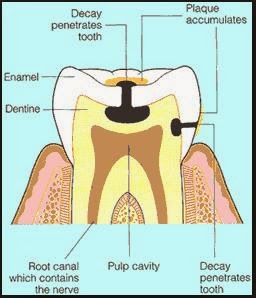
Usually, dental decay is fairly easy to detect. When a cavity is just beginning, it is typically identified by a brown or white color or a change in the translucency of the enamel of the tooth. The dentist or dental hygienist uses a special dental instrument called an explorer to feel the suspect area and check its hardness. If the area is hard, in other words, if no break in the enamel layer is detected, we feel there is not a cavity present. If, however, the surface feels soft and the explorer "sticks" in the suspect site, we feel a cavity is present.
Fluoride makes our enamel stronger, but dentin decay is harder to detect
Detect decay by inspecting the color and hardness
Usually, dental decay is fairly easy to detect. When a cavity is just beginning, it is typically identified by a brown or white color or a change in the translucency of the enamel of the tooth. The dentist or dental hygienist uses a special dental instrument called an explorer to feel the suspect area and check its hardness. If the area is hard, in other words, if no break in the enamel layer is detected, we feel there is not a cavity present. If, however, the surface feels soft and the explorer "sticks" in the suspect site, we feel a cavity is present.
Fluoride makes our enamel stronger, but dentin decay is harder to detect  Because of the widespread use and availability of fluoride in our drinking water, foods, and oral care products, we are seeing a different decay pattern. The appearance is different from the typical pattern of decay and more difficult to detect. As the outer surface of the enamel absorbs fluoride (from toothpaste, for example), the enamel becomes very resistant to demineralization and eventual decay. If there is a small break in the integrity of the enamel, a pit or groove where decay-causing bacteria can live, the bacteria can dissolve the enamel in such a way that the hole in the enamel cannot be detected. Once the decay-causing bacteria reach the underlying dentin, the acids eat away at that substance and quickly make a large cavity - but one that still cannot be easily seen or detected. In this way the enamel becomes undermined. A dentist looking at such a small cavity would think it very easy to restore. However, once the decayed portion of the enamel is removed and the dentin becomes visible, the true extent of the damage becomes obvious. The small cavity becomes a big cavity.
 One of the major problems with decay that appears to occur only in the dentin is in the detection. If a radiograph is taken a part of the periodic examination process, we may be able to see dentin decay if it is moderate to extensive. Decay seen on radiographs is typically two to seven times greater in the tooth. Modern high-speed radiographic film and reduced x-ray exposure makes it more difficult to detect early decay on radiographs.
You can prevent decay by using fluoride
The conscientious application of a source of topical fluoride, through either an over-the-counter dentifrice or a prescription fluoride product, and thorough plaque removal are essential. Bonded sealants are also an effective protection against dentin decay. We strongly advice these procedures. Periodic examinations at intervals recommended by the dentist catch decay at the earliest possible time. This is the only way to keep small problems from developing into larger problems.
Click here to check out our blog post on foods that cause decay.
Click here for our post on how to prevent decay.
If you have any questions about dentin decay, please feel free to ask us.
One of the major problems with decay that appears to occur only in the dentin is in the detection. If a radiograph is taken a part of the periodic examination process, we may be able to see dentin decay if it is moderate to extensive. Decay seen on radiographs is typically two to seven times greater in the tooth. Modern high-speed radiographic film and reduced x-ray exposure makes it more difficult to detect early decay on radiographs.
You can prevent decay by using fluoride
The conscientious application of a source of topical fluoride, through either an over-the-counter dentifrice or a prescription fluoride product, and thorough plaque removal are essential. Bonded sealants are also an effective protection against dentin decay. We strongly advice these procedures. Periodic examinations at intervals recommended by the dentist catch decay at the earliest possible time. This is the only way to keep small problems from developing into larger problems.
Click here to check out our blog post on foods that cause decay.
Click here for our post on how to prevent decay.
If you have any questions about dentin decay, please feel free to ask us.
Teeth can become sensitive for many reasons. Sometimes, the sensitivity
is an indication of a potentially serious problem. Other times, the
dentally related problem may be small but the effects (the sensitivity)
are extremely aggravating.
What do we mean when we say "sensitive teeth?"
Twinges of pain or discomfort in our teeth in certain situations such as drinking or eating cold things, drinking or eating hot things, eating sweets, and touching the teeth with other teeth or the tongue. Your symptoms will involve reactions to temperature or pressure. Sensitivity to cold drinks or foods is the most common symptom.
Two types of sensitivity:
1. Dentinal sensitivity
When the dentin (middle layer) of a tooth is exposed. Normally, dentin is covered by enamel. Dentin becomes exposed when the outer protective layers of enamel wear away. Dentin contains tiny openings called tubules. Inside each tubule lies a nerve branch that comes from the tooth's pulp (the nerve center of the tooth). When the dentin is exposed, cold or hot temperature or pressure can affect these nerve branches, causing sensitivity.
Causes:


- Inadvertent notching of the tooth surface and/or recession of the gum
tissue (exposing the root surface of the tooth) caused by improper
brushing: either brushing too hard, brushing with a toothbrush that is
too hard, or using an improper brushing technique, which will wear away the enamel layer. This sensitivity can
range from mild to extreme; the degree of sensitivity does not appear
to be related to the size of the root exposure or notch.
- Poor oral hygiene, allowing tartar to build up at the gum line
- Untreated cavities
- An old filling with a crack or leak
- Receding gums that expose the tooth's roots, often caused by periodontal disease
- Gum surgery that exposes the tooth's roots
- Tooth whitening in people who have tooth roots that already are exposed
- Frequently eating acidic foods or drinking acidic liquids
- Purposeful repositioning of the gum tissue during gum surgery can also
lead to tooth sensitivity. While recession from brushing is slow, gum
recession following gum repositioning occurs very quickly. The portion
of the tooth once covered with gum and bone may now be exposed. Root
sensitivity in these instances can be quite severe and immediate. It
can sometimes last four months or years if not treated.

2. Pulpal sensitivity
The reaction of the tooth's pulp. The pulp is a mass of blood vessels and nerves in the center of each tooth. Pulpal sensitivity affects only a single tooth.
Causes:
- Decay or infection. When a tooth is decayed, temperature
changes and sweets will make it sensitive. The solution can be as simple as
removing the decay and placing an appropriate
restoration.
- A recent filling. A tooth may be sensitive to cold for
several weeks after you get a filling. The metals in amalgam (silver)
conduct the cold very well, transmitting it to the pulp. Bonded
(tooth-colored) fillings require etching the tooth with acid before the
filling is placed. In some cases, this etching removes enough enamel to
make the tooth sensitive. If a filling is defective
or failing, leakage around the filling may cause the tooth to become
sensitive. The solution can be as simple as
removing the defective filling and placing an appropriate
restoration.
- Excessive pressure from clenching or grinding
- A cracked or broken tooth. If the tooth is fractured, you may be sensitive to
temperature changes or when chewing food. This fracture condition may
be hard to diagnose. If you think you might have this type of
sensitivity, read our blog post on "cracked tooth syndrome."
- A tooth can become sensitive after it has
been prepared (drilled) for a restoration (filling). You may have been
anesthetized during the procedure, so you did not feel any discomfort
when the nerve in the tooth reacted to the heat generated by the drill.
The closer the drill comes to the nerve, the more likely it is to cause
a sensitivity problem. The high-speed rotation of the bur in the drill
generates heat, and the response of the nerve to heat is inflammation. This inflammation is felt by you as a "sensitivity." If the decay,
fracture, or drilling was not too deep, this sensitivity will decrease
over time. A week to a month or two is not an unusual length of time
for the sensitivity to disappear. A good sign is the continued decrease
of sensitivity. However, if the occlusion (bite) is off after the
restoration has been placed, the tooth may either become sensitive or
may stay sensitive. Once the bite is adjusted, though, the sensitivity
should disappear.
- A dying nerve. This can be the
result of a deep cavity. Commonly, the sensitive tooth holds an old
large filling. The nerve may be damaged during drilling and the nerve
has been dying gradually ever since. If this is the problem, the tooth
will need endodontic treatment (root canal treatment).
 See this post about the 10 biggest causes of tooth sensitivity.
How will the doctor diagnose sensitivity?
Your dentist will look at your dental history and will examine your mouth. You also will need x-rays to show if there is decay or a problem with the nerve. The dentist will ask about your oral habits. Grinding or clenching your teeth can contribute to sensitivity. Your dentist also will look for decay, deep fillings, and exposed root surfaces. During the consultation, your dentist uses an instrument called a spray
gun to dispense air across every area of each tooth in order to locate
the sensitivity. He or she may use an explorer - a metal instrument with a sharp point - to test teeth for sensitivity.
How will it be treated?
- Your dentist or
dental hygienist will clean your teeth. If your teeth are too sensitive
to be cleaned, your dentist may use a local anesthetic or nitrous oxide
before the cleaning.
- If there is a notch
in the tooth or the shape of the defect is appropriate, the defect is
restored (filled in) with a bonded material. This can give immediate
relief -- sometimes partially, sometimes fully.
- When there is no defect
to be restored, the exposed and sensitive root surfaces are covered
with a dentin-bonding or other material. This material is invisible and
has very little thickness, so you do not notice any change in the
appearance of the tooth; but it works. It may have to be reapplied
after several months because the bonding material has worn away by
tooth-brushing.
- If you have pulpal sensitivity and the tooth's nerve is damaged or dying, you will need a root canal. Your dentist will remove the nerve and place a non-reactive substance in the space where the nerve was. The tooth will no longer have a continuous barrier of enamel to protect it. Therefore, it will be restored with either a composite filling or a crown.
- Your dentist may apply a fluoride varnish to protect your teeth. This
temporarily reduces sensitivity and strengthens your teeth.
- Using fluoride toothpastes and fluoride mouth rinses are home will help to reduce sensitivity. You can also buy toothpastes just for sensitive teeth. You should choose a fluoride mouth rinse that uses neutral sodium fluoride.
How can I prevent it?
If you have any questions about tooth sensitivity, please feel free to call our office for a consultation at (512) 250 - 5012.
What is dental decay, and how do dentists fix it?
Dental caries (decay) is a bacterial infection, first of the enamel, then of the dentin of the tooth. The tradition in dentistry has been to surgically remove the diseased portion of the tooth by "drilling" out the decay and then filling the resulting hole in the tooth with some inert material. As most adults know, this procedure will be performed over and over again when new decay begins or when the filling (often silver) breaks or the tooth fractures.
Click here to learn about decay in young children.
Why should I practice prevention?
Would it not be better to eliminate the cause of the infection and thus not be forced to have big holes drilled in the teeth? We believe the bacterial cause of the infection should be addressed.
How do I prevent dental decay?
There are several positive steps that you can take to reduce your risk of dental decay.
A. At the dentist's office
1. First, all the active decay in your mouth should be treated immediately.
2. Next, all teeth that would benefit from sealants should be treated.
- Why? This will prevent bacteria from reaching into the pits, fissures, and grooves that normally exist on the occlusal (biting) surfaces of teeth. Any stray bacteria that may still be in the sealed area are effectively cut off from their source of food and become inactive. Although sealants are most effective on teeth that have not been previously restored, they can be successfully placed on teeth filled with bonded fillings.
3. The infection can be treated with antimicrobials.
4. We believe that the use of a fluoridated mouthrinse twice daily or use of a prescription fluoridated dentifrice as directed provides a great advantage.
5. We may also prescribe a chlorhexidine mouthrinse, an antimicrobial oral rinse that has a great effect on Streptococcus mutans.
B. In your daily life
6. Your diet and oral self-care are important in dental decay prevention. When you eat junk food and drink sugary liquids, your teeth are more prone to decay. The more frequently you snack, the more prone your teeth will be to decay.
 7. If your brushing and flossing are not effective, your teeth will be more prone to decay. When you can't brush after a meal, at least rinse your mouth with water within 15 minutes to dilute the acids forming from the ingested food or drink.
8. If you have a diminished salivary flow, take frequent sips of water during the day to help dilute the acids produced by the bacteria.
What if decay keeps coming back?
If you have a continuing problem with active decay, we recommend more frequent preventive recare appointments. It has been repeatedly shown that patients who have good oral self-care and maintain a recare interval of 3 to 4 months have many fewer dentally related (cavities or gum disease) problems.
Present-day dental suggestions are based on proven scientific information. You might need to have your teeth cleaned by the hygienist twice each year, or you may need to be seen more frequently.
For certain individuals, we also suggest testing the oral bacterial levels to determine the magnitude and presence of a Streptococcus mutans infection and to determine your risk level for future dental disease.
If you have any questions about the prevention of dental decay, please feel free to ask us.
7. If your brushing and flossing are not effective, your teeth will be more prone to decay. When you can't brush after a meal, at least rinse your mouth with water within 15 minutes to dilute the acids forming from the ingested food or drink.
8. If you have a diminished salivary flow, take frequent sips of water during the day to help dilute the acids produced by the bacteria.
What if decay keeps coming back?
If you have a continuing problem with active decay, we recommend more frequent preventive recare appointments. It has been repeatedly shown that patients who have good oral self-care and maintain a recare interval of 3 to 4 months have many fewer dentally related (cavities or gum disease) problems.
Present-day dental suggestions are based on proven scientific information. You might need to have your teeth cleaned by the hygienist twice each year, or you may need to be seen more frequently.
For certain individuals, we also suggest testing the oral bacterial levels to determine the magnitude and presence of a Streptococcus mutans infection and to determine your risk level for future dental disease.
If you have any questions about the prevention of dental decay, please feel free to ask us.