Showing posts with label dental implant. Show all posts

Monday, January 30, 2017

Congenitally Missing Teeth

Some of us will have 32 teeth develop during our lifetime. This has been considered a normal complement of teeth. More often than not, however, we do not develop a full set of 32 teeth. It is quite common for people to be missing one or more of the third molars (wisdom teeth). And as the jaw sizes of modern human beings have decreased in size, it is not unusual that there is no room for the proper placement of the third molars in a mouth, and they must be extracted.

Not as common, but not at all unusual, is a condition in which certain permanent front teeth never develop. When permanent teeth don’t develop, they are considered to be congenitally missing. The term for this condition is congenitally missing teeth. When this happens, it is frequently one or both of the upper lateral incisors, which are smaller teeth on either side of the two top front teeth. Less often, the permanent eyeteeth (canines) or premolars don’t develop.

The problem that results from congenitally missing teeth involves the space where the tooth (teeth) should have been. The teeth nearest the space shift into different positions to fill the gap, often resulting in a crowded smile—when in fact, some teeth are missing!

The problems resulting from missing permanent teeth can be reduced or eliminated with early detection and a plan for future treatment. The usual treatment involves orthodontics to move the permanent teeth into better position or keep the permanent teeth in the correct location. Because we treat missing lateral incisors so often, the treatment routine is well established. The best aesthetics, the most natural look, will be achieved by leaving the adjacent permanent central incisors and canine teeth in their customary places.

When there are missing lateral incisors, it is likely that we will recommend moving the eyeteeth (canines) into their positions. This will keep the bone in the missing tooth space at the proper level. We will then recommend moving the eyeteeth back into their proper positions. This may sound like extra treatment, but it is needed to keep the bone at the proper height for future tooth replacement treatment.
The sequence of treatment is orthodontics as early as necessary to maintain the space. The further the teeth have shifted from this original position, the more orthodontic treatment will be necessary. Then, while the child and mouth are growing, a removable replacement tooth is made. This appliance is worn until the teeth are ready to receive the implant or bridge, after age 18 or so when the mouth and dental structures are more mature.


When the permanent teeth further back in the mouth are missing, it is common for baby teeth to be retained in these spaces. Sometimes the baby teeth can last for years, but they do not have the root structure to remain stable over a lifetime. Because the retained baby teeth are meant for a small mouth, they do not have the right size, shape, or function as the permanent teeth. When lost, they can be replaced with implants or a bridge. Your own particular situation will determine the best course of treatment. 

Wednesday, January 25, 2017

Implants, Crowns, and Bridges vs. Natural Teeth

Nothing can replace the natural teeth you were born with for chewing and function. However, very few people go through life without having teeth filled, crowns (caps) placed, or bridges and implants used to replace missing teeth. Crowns, bridges, and implants are the best answer and closest to your natural teeth, but they are not the same as healthy, natural teeth.

Crowns

Crowns are used to reconstruct a single tooth broken down by dental decay. Crowns are made of ceramic, resin, porcelain, porcelain plus metal, or resin plus metal materials. They are bonded or cemented onto the prepared tooth and cannot easily be removed from the tooth once placed. If the tooth was in good alignment before the crown was prepared, the crown will be in good alignment. If the tooth was misaligned before the crown, sometimes the crown may be made to obtain a more ideal shape and position. It is cleaned and flossed just like a natural tooth and is most like real teeth.

Bridges

Bridges are crowns that are attached together, suspending the crown portion of a false tooth in or over the space left by the missing tooth. A bridge can be used to replace one or several teeth. Sometimes a bridge is used to splint loose teeth together in order to make the teeth more stable. Bridges are usually made of metal covered with either porcelain or resin. Some of the newer bridges are made of all resin or all ceramic materials. They are cemented or bonded onto the existing prepared teeth and are not easily removed once placed. The bridge teeth can be brushed the same as natural teeth, but since they are attached together, must be flossed differently by using a floss threader or other device.
The teeth are generally the same shape as natural teeth. However, if the existing teeth (abutments) that are used to anchor the bridge have moved from their original position because a tooth or teeth have been missing for years, the added tooth (pontic) may be longer or shorter than the tooth that it is replacing. With a bridge, the false tooth will most often butt up against the soft tissue ridge where the removed tooth was.
The shape of the tongue side of the false tooth varies. It is usually smaller on the tongue side and completely fills the space. Food will have more of a tendency to collect in this area, so you must be prepared to clean it. If the missing tooth has been gone a long time, the ridge may have shrunk considerably, and the pontic tooth will be longer that the teeth on either side. If this is the case, there are several periodontal procedures that can be done prior to the construction of the bridge. These procedures will build up the tissue to its former height. The more your mouth has changed from its normal state, the harder it is to make new teeth look and feel natural.

Implant Crowns

Implant crowns are used to replace single or multiple missing teeth. They are either cemented or screwed-retained onto an implant fixture. The crowns are made of porcelain or resin and metal. But they have some significant differences from the natural teeth they replace. Teeth are supported by a root or roots that are irregular in shape. Implants are round. The cross-sectional of the implant will never match that of the tooth it is replacing. A multirooted tooth may be replaced by a single implant, so the manner in which an implant crown comes out of the soft tissue ridge will appear different from a natural tooth. There will be more space between the implant root and the adjacent teeth. Implant crowns are often cemented with temporary cement. This allows the dentist to easily take off the crown and evaluate how the implant is doing. Crowns on teeth are usually cemented with a final cement. Implant-supported crowns are wonderful, but not the same as natural teeth with crowns. Be prepared for some differences. Expect more maintenance on your part and in the dental office with crowns, bridges, and implants.


Smokers take note: There is a heightened risk of dental implant failures among smokers—as much as 20% greater failure rate!

Monday, November 7, 2016

Dental Sealants Prevent Cavities and More Kids Need Them, CDC Says

There's a quick and easy way to prevent 80 percent of cavities, but most kids don't get it, federal health officials said Tuesday. The treatment, dental sealants, works well, but only 60 percent of kids who need sealants get them, the Centers for Disease Control and Prevention says.
                       
    
Dentist inspecting boys mouth before treatment. Universal Images Group / UIG via Getty Images

One good solution: doing it at school. But states often lack the funding to pay for such programs, and often bureaucratic requirements about having dentists on site can hold them up, also, the CDC said.

"Many children with untreated cavities will have difficulty eating, speaking, and learning," said CDC director Dr. Tom Frieden.

"Dental sealants can be an effective and inexpensive way to prevent cavities, yet only one in three low-income children currently receive them. School-based sealant programs are an effective way to get sealants to children."
The CDC says that 20 percent of kids and teenagers have untreated dental decay by the time they are 19. Kids with constant toothaches cannot eat properly and have trouble paying attention at school.

Related: Do Kids Need Dental Sealants?

Even though they are endorsed by the CDC and the American Dental Association, only 43 percent of 6- to 11-year-old children have a dental sealant, federal surveys show.

"Low-income children were 20 percent less likely to have sealants than higher-income children," the CDC's Susan Griffin and colleagues wrote in a report released Tuesday.                    

"School-age children without sealants have almost three times more cavities than children with sealants," the CDC added.

"Applying sealants in school-based programs to the nearly 7 million low-income children who don't have them could save up to $300 million in dental treatment costs."

That's because a filling costs more. In addition, once a tooth has been drilled to put in a filling, it's never as stable again.
But many states struggle to pay for such programs, the CDC team found.

"Federal funding of state oral health programs is largely com­petitive and varies widely by state," they wrote. "Many state and local school-based sealant programs cover part of their expenses by Medicaid billing."

And Medicaid, the joint state-federal health insurance plan for children and low-income people, is already badly stretched in most states.
One big expense is paying a dentist to oversee the program, the CDC found. One solution: Allow lower-paid professionals to administer sealant programs. At least one state has already done so.

"For example, in South Carolina, school-based sealant programs managed and staffed by dental hygienists deliver sealants in approximately 40 percent of high-need schools," Griffin and colleagues wrote.

"CDC currently provides funding to 21 state public health departments to coordinate and implement school-based and school-linked sealant programs that target low-income children and those who live in rural settings," the agency added.

It said the federal government plans to do more. It will classify pediatric dental services as an essential health benefit to be covered by dental insurance as part of the Affordable Care Act, for instance, and match state Medicaid and CHIP costs for sealants.
The sealants are plastic-based coatings that get into the cracks and crannies of molar teeth, stopping food and bacteria from starting the chemical reaction that leads to cavities.
 Studies show they are safe and stop tooth decay, even when they are layered over an existing pre-cavity.

"Studies on sealant effectiveness indicate that sealants delivered in clinical or school settings prevent about 81 percent of decay at two years after placement, 50 percent at four years, and can continue to be effective for up to nine years through adolescence," the CDC said.

 The American Dental Association (ADA) agrees, and says many people don't know that dental insurance often pays for them.

"Dental sealants are one-third the cost of a filling, so their use can save patients, families, and states money," the Pew Charitable Trusts, an independent, public service-oriented nonprofit, says in a statement. "Sealant programs based in schools are an optimal way to reach children — especially low-income children who have trouble accessing dental care."
 One worry that parents may have is about BPA, a chemical found in the sealants that is increasingly linked with health risks. The ADA says the benefits of sealants far outweigh any perceived risk.

"The potential amount of BPA patients could be exposed to when receiving sealants is minuscule, and it's less than the amount a person receives from breathing air or handling a receipt," the ADA says.

By: Maggie Fox, NBC News
http://www.nbcnews.com/health/kids-health/dental-sealants-prevent-cavities-more-kids-need-them-cdc-says-n668266

If you have questions or would like to schedule an appointment, please contact Omni Dental Group at one of our three office locations listed below:

North Austin on Hymeadow Drive: (512) 250-5012
Central Austin on Jollyville Road: (512) 346-8424
South Austin on William Cannon: (512) 445-5811

Monday, August 29, 2016

Why You Need To Visit A Dentist Now?


I don’t have any reason to visit a dentist, my teeth are perfect and healthy!

That is what everyone says when being asked to visit a dentist. But really, it is not until you start having serious pains in your teeth before you consider visiting a dentist.
Here are four reasons why you should consider visiting a dental care clinic now:

#1. Correction of Wrong Dentition
Most of us grew up with having more than enough teeth in the mouth and we see it as a normal thing even though they overlap each other.
A dentist will help find corrective measures in helping your teeth have the best dentition you never thought you could have.

#2. Mouth Cleaning and Cleansing
Most people have tartar (an incrustation that forms on the teeth and gum) formed underneath their teeth and close to the gums.
These harbor lots of microorganisms that later affect the oral health. A dentist would notice the tartar and carry out what is called scaling and polishing to remove every traces of the tartar before it gets to its worse stage.

A dentist will help you to remove food remnants that hides between the teeth. Food remnants that hide in the teeth include remnants of meat, fish, vegetables and they keep decaying in between the tooth.
You don’t have to wait till it decays and destroy your oral health, visit a dentist who will help you floss the teeth with a waxy thread.

#3. Prevention and Control of Oral Diseases
A dentist takes note of everything that might lead to a chronic disease and takes care of before it gets out of the primary stage.
It is advisable to visit a dentist at least once in every three months. Being busy is not an excuse anymore, so just make time within that three months to see a dentist.

#4. Placing fillings or administering anesthetics
Dental fillings or restoration are used to fill in the cavities caused by tooth decay. Instead of removing the tooth after suffering a tooth decay, your dentist will help check what the possible solution to it might be so you get relieved of the pain as soon as possible.
It is either placed with fillings if the tooth is not decayed to a bad extent and might be extracted if the condition of the tooth is bad.

Is that all a dentist can do? Of course not.
A dentist can also help in diagnosing oral diseases, creating treatment plans to maintain or restore the oral health of patients, interpreting x-rays and diagnostic health, monitoring growth and development of the teeth and jaws.

Source: The Huffington Post
http://www.huffingtonpost.com/adeyemi-adetilewa/dental-care-why-you-need-_b_11707700.html
_________________________________________________________________________________
If you have questions or would like to schedule an appointment, please contact Omni Dental Group at one of our three office locations listed below:

North Austin on Hymeadow Drive:  (512) 250-5012
Central Austin on Jollyville Road:  (512) 346-8424
South Austin on William Cannon:  (512) 445-5811

Friday, July 18, 2014

Implants: Procedural Overview

Compared to a routine dental filling or crown (cap), replacement of a missing tooth or teeth with implants is a more complicated and lengthy process. It will take several phases. A periodontist or an oral surgeon will place the implant surgically. Then we will place the tooth or visible portion.

Phase One
The specialist evaluates the position, suitability, and strength of the bone that will surround the implant. This information determines the length and width of the implants and how many implants will be necessary to replace the missing teeth. Impressions of all your teeth will be taken for study models in order to design the shape of the tooth or teeth to be implanted. A surgical guide will be made to indicate to the surgeon where the implants should be placed.  

Phase Two
Surgical procedure is done to place the implant in the bone. A local anesthetic is given, and the gum tissue is lifted to expose the implant site. The implant is placed into the bone and the gum is closed over it. You will not see the implant while integration with the bone takes place. The integration takes 4 to 6 months. After this time, the site is opened again and a healing collar will be threaded into the implant. This will guide the tissue into a shape that is needed for the future crown(s). The time that the healing collar needs to be in place will vary from person to person, but will be at least several weeks.

Phase Three
Once the tissue shape is sufficient, specific attachments and components will be fitted to the implant. The implant components are similar in function to the wall or plaster anchors used to hang pictures on drywall. The healing collar is removed. Implants transfer copings, analogs, and other items are used to take an impression of the site. The healing collar is then put back on. The impressions and implant components are sent to the laboratory for fabrication of implant posts and temporary acrylic crowns.

When the temporary crown or bridge is returned from the laboratory, the healing collar is removed and the implant attachments are fasted to the implant. The temporary crowns are then seated and adjusted. They will be held in place by temporary cement or with screws, depending on your certain situation. We will explain the advantages and disadvantages of each in your particular case at the time you decide to have the implant

Temporary crowns are placed because the bone that supports and surrounds the implant must be given the opportunity to be put into function gradually. Implant techniques dictate that the implants be slowly brought into biting function. This means you will be returning several times to have more acrylic added to the temporary crown. After the implant and temporary crown have been in biting function for a few months, the final crown(s) will be fabricated and cemented or screwed into place.

Maintaining All Your Teeth
To keep your implants and your natural teeth healthy and functional for the longest time possible, clean the implant and your other teeth daily, as instructed. You will also need to come in for dental hygiene recare appointments at a 3- to 4-month interval. You have invested time and money in these state-of-the-art tooth replacements. Maintaining them as instructed will give you the best chance of success.

We feel that the benefits of replacing teeth with implant-supported crowns and bridges far outweigh the inconvenience of the long start to finish time. This is especially true when the teeth on either side of the implant are sound, unfilled teeth that would not otherwise require dental treatment. Implants help you preserve your nature tooth structure.

If you have any questions about dental implants, please feel free to ask us.

Monday, June 30, 2014

What Are Implants?

Have you lost your teeth due to: severe tooth decay, gum disease, trauma, or even a failed root canal? You may qualify for implant treatment. Dental implants are used to replace one or more missing teeth in your mouth. Implants are made of titanium or similar materials that are well suited to the human body. Implants are artificial replacements for teeth roots that support a restoration or a dental appliance. 


Twenty-five years ago, if someone described how missing teeth could be replaced with implants, it might have been called a miracle. Ten years ago, the use of dental implants to replace missing teeth might have been called astounding. Today, implant procedures are called routine. We would like you to have a basic understanding of what implants are, what can be expected from them, and what limitations they might have in your specific area of need.

dental implant Austin
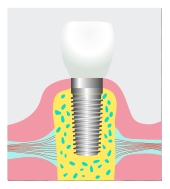
A dental implant is a synthetic metallic root substitute that is placed or implanted in the jaw bone. It can be used to replace a single missing tooth, provide an abutment (anchor or retainer), replace several missing teeth, or provide added retention to a removable dental appliance such as a full denture. In fact, if you are missing all of your natural teeth, it is possible to have maxillary (upper) and mandibular (lower) fixed replacements. The replacements do not come out and you cannot remove them yourself.

Two separate events are needed when replacing a missing tooth with an implant. First is the surgical phase in which the implant is placed. In the second phase, the replacement teeth are constructed and fixed into proper position.

The implant placement procedure involves making a small incision in the gum area where the implant is to be placed, preparing a site in the underlying bone, inserting the implant into the prepared site, and closing the tissue over the implant with several sutures. This area is left undisturbed, usually for 4 to 6 months. More healing time may vary due to the density of your bone. The lower jaw is composed of bone that is more dense than that of the upper jaw. This healing time allows for the slow integration of the implant within your jaw. The implant is held in place by the bone.
http://paulkorb.com/wp-content/uploads/dental_implant_01.jpg 
After the healing and integration of the implant, the placement site is exposed by reopening the gum. A post will then be fastened to the implant by cement or with internal threads. The crown, bridge, or other type of replacement will be attached to this post. Some dentists prefer to do all phases of the implant procedure themselves, but many choose to perform either the surgical or prosthetic (the actual construction of the replacement device) only. If this is the case, a periodontist or oral surgeon will perform the surgical portion of the implant placement.

Implants are very successful. Maxillary and mandibular implants are more than 90% successful. Lower implants have a somewhat higher success rate than upper implants. Occasionally, implants fail, but it is not common. Chances of an implant failure, many times, can be determined during or after the surgical phase before the replacement tooth or teeth are constructed.

Smokers take note: There is a heightened risk of dental implant failure among smokers - as much as a 20% greater failure rate!

We will discuss with you the requirements and options for your particular situation. There are usually several possibilities for effectively replacing missing teeth. It is important to decide on the design of the implant-retained replacement prior to the actual implant surgical procedure. Position and alignment of the replacement teeth need to be carefully considered before determining the location of the implant.

If you have any questions about implants, please feel free to ask us.