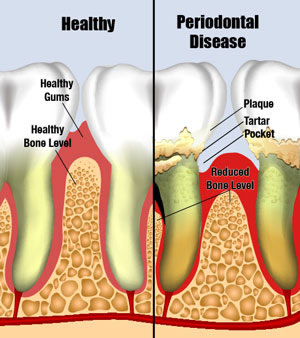
Periodontal disease is an infectious process classified
according to how much damage has been done to the structures surrounding the
teeth, namely the gingiva (gums) and bone. It
is an infection in your mouth. It can happen anytime, around your teeth,
affecting some or many of your teeth to varying degrees. There are genetic predisposing
factors to periodontal disease, and our immune systems play a role in gum
health, but it is usually related to how well you are able to keep your teeth
clean through proper oral self-care. The better you clean your teeth to remove
all the plaque bacteria, the less likely you will be to develop periodontal
disease.
Progress of the
Disease
The bacteria that cause this disease first cause the gum
tissue to become inflamed and pull away from the teeth. As the problem becomes more
serious, the bone that supports the teeth also becomes infected and begins to
break down and dissolve. The teeth then become loose. Once the bone disappears,
it is extremely hard, if not impossible, for new bone to be rebuilt. The damage
is permanent and your teeth, the surrounding bone, and your general health will
be compromised.
Periodontal disease is classified into several types. The mildest
form of this infection will show up in red and swollen gum tissue that bleeds
easily. There is seldom any pain involved at this stage. You may also notice
that your breath becomes offensive and you feel the need to use mouthwash. Our
sense of smell does become immune to the same odor, so we can lose our ability
to detect our own offensive, diseased breath. As the disease progresses, the
gum tissue becomes more red and swollen, more bleeding can be seen, and the
teeth begin to become loose. This tooth mobility is a sign that there is a
severe problem. There may still be no pain at this advanced stage. As more and
more bone is lost and more teeth become involved in the infection, it becomes
harder to treat. At this point, many times, the management of your problem will
involve periodontal surgical procedures. If this is the case, you may be
referred to a periodontist (gum specialist) for further treatment. Most of the
time, periodontal disease starts and continues because of neglect. Brushing and
flossing of teeth are not being done effectively on a daily basis. You may have
been neglectful in getting your teeth checked and cleaned within the time frame
intervals you need. Once we have diagnosed the disease, we will inform you of
the problem and suggest treatment. If treatment is not completed, however, the
disease will continue to progress. Unfortunately, the disease is quite
invisible to most people until severe and possible irreversible damage has occurred.
Solution
If it has been diagnosed in the early stages and has not
progressed to bone loss, a proper cleaning (prophylaxis) will solve the
problem. Scaling and root planing over multiple appointments may be needed for
more advanced cases. In the most advanced cases, periodontal surgery and tooth
loss are inevitable. You will receive an estimate of fees for the recommended
treatment.
Periodontal disease is a condition that must be treated
quickly. We believe that if the infection is aggressively treated in its early
stages, conservative periodontal treatment may be possible and effective.
Although we do not automatically rule out periodontal surgical intervention, we
hope you can either avoid it or reduce the amount you will need.
Successful treatment of your periodontal problem will depend
on several factors. But the most important of these is your ability to perform
excellent oral self-care—brushing, flossing, and the use of periodontal aids—on
a routine, daily basis. Without this, periodontal treatment will fail, and the
disease will return.